2025-09-03 中国科学院(CAS)
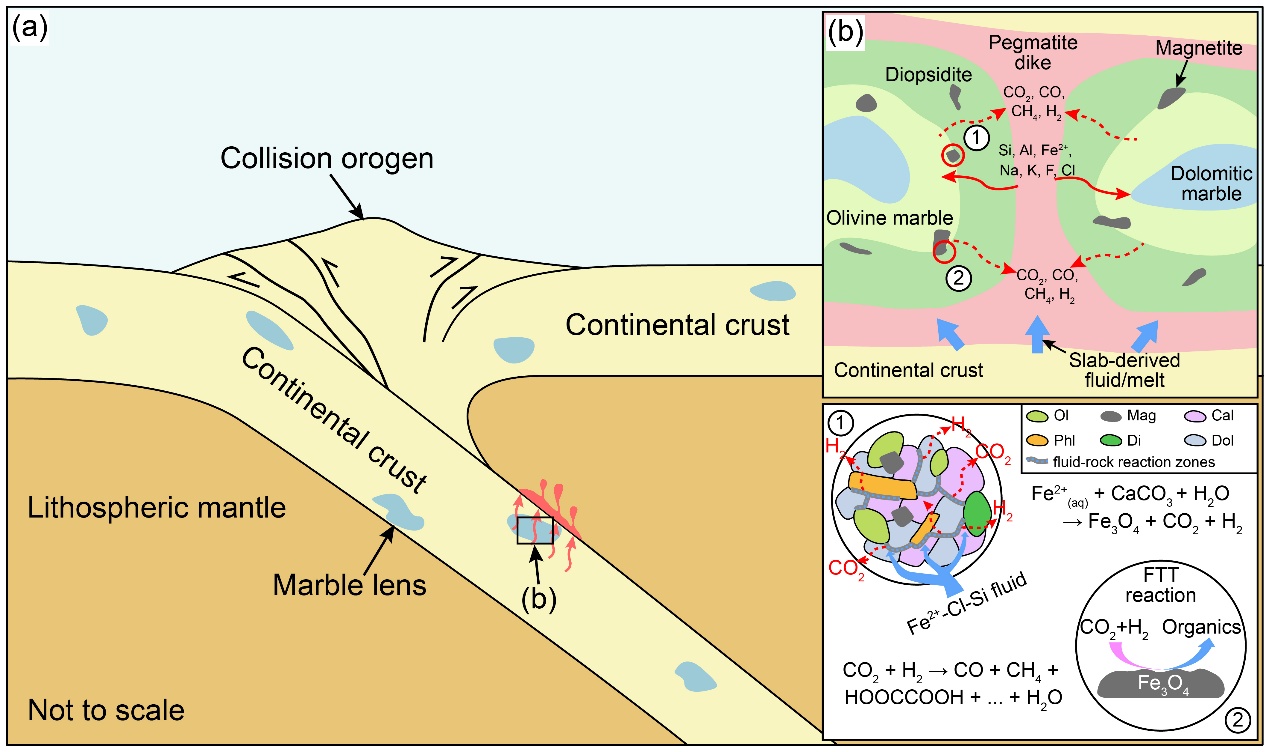
Schematic illustration of H2 generation and abiotic organic synthesis during metasomatism of dolomitic marble by ferrous chloride-rich silicic fluids in a continental subduction zone. (Image by FEI Chenhui).
<関連情報>
- https://english.cas.cn/newsroom/research_news/earth/202509/t20250903_1052719.shtml
- https://www.pnas.org/doi/10.1073/pnas.2423043122
高変成条件下における塩化第二鉄豊富な珪酸質流体と大理石の相互作用時の非生物的合成 Abiotic synthesis during the interaction of ferrous chloride–rich silicic fluids with marble under high-grade metamorphic conditions
Chenhui Fei, Shun Guo, Yibing Li, and Jingbo Liu
Proceedings of the National Academy of Sciences Published:August 28, 2025
DOI:https://doi.org/10.1073/pnas.2423043122
Significance
Abiotic organic synthesis in geological processes is closely linked to the Earth’s carbon cycle and the origin of early life. Our research revealed that the infiltration of ferrous chloride–rich silicic fluids into dolomitic marble induced a decarbonation reaction (T >670 °C, P >1.0 GPa) that produced H2 and magnetite, facilitating magnetite-catalyzed organic synthesis. This study highlights the role of aqueous Fe in the generation of H2 and magnetite and extends the scope of research on abiotic organic synthesis in natural samples from low-grade to high-grade metamorphic conditions.
Abstract
Ferrous chloride–rich silicic fluid and melt infiltration led to the decarbonation of dolomitic marble in the Chinese Sulu ultrahigh-pressure metamorphic terrain under temperatures ranging from 670 to 800 °C, pressures from the aragonite + albite to calcite stability fields and the oxygen fugacities between the hematite–magnetite and pyrite–pyrrhotite–magnetite buffers, resulting in the formation of olivine marble and diopsidite. The inclusions in zircons trapped during the decarbonation process suggest that the H2-producing reaction 3FeCl2 (aq) + 3CaCO3 + H2O = Fe3O4 (magnetite) + 3CaCl2 (aq) + 3CO2 + H2 occurred and that it induced magnetite-catalyzed Fischer–Tropsch-type synthesis, as indicated by the presence of whewellite, disordered carbonaceous material, CH4, and CO in the inclusions. The results of this study highlight the role of aqueous Fe in generating H2 and magnetite and have far-reaching implications for carbon speciation and solubility in deep fluids and for endogenic abiotic synthesis, which may be pivotal in the prebiotic occurrence of organic compounds on Earth.