2025-08-22 京都⼤学
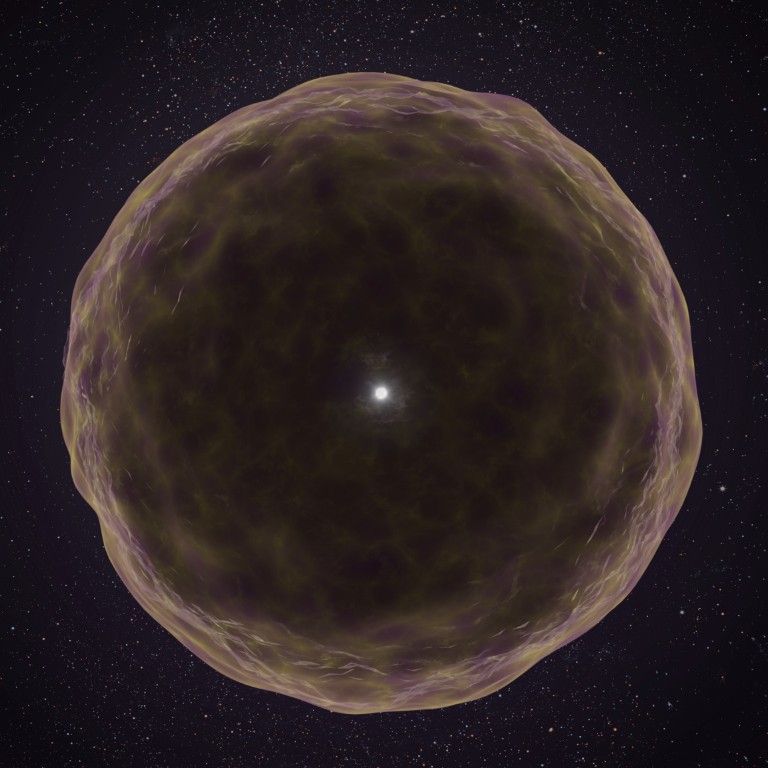
超新星SN 2021yfjの爆発直前の大質量星の様子の想像図。外層の大部分が放出されて、シリコンや硫黄を含む中心部がむき出しになっている。©W. M. Keck Observatory / Adam Makarenko
<関連情報>
- https://www.kyoto-u.ac.jp/ja/research-news/2025-08-22
- https://www.kyoto-u.ac.jp/sites/default/files/2025-08/2508_Nature_Maeda_relj%20web-87729743871640c16cdeec65cd5e0491.pdf
- https://www.nature.com/articles/s41586-025-09375-3
極端に剥離した超新星がシリコンと硫黄の形成場所を明らかにする Extremely stripped supernova reveals a silicon and sulfur formation site
Steve Schulze,Avishay Gal-Yam,Luc Dessart,Adam A. Miller,Stan E. Woosley,Yi Yang (杨轶),Mattia Bulla,Ofer Yaron,Jesper Sollerman,Alexei V. Filippenko,K-Ryan Hinds,Daniel A. Perley,Daichi Tsuna,Ragnhild Lunnan,Nikhil Sarin,Seán J. Brennan,Thomas G. Brink,Rachel J. Bruch,Ping Chen,Kaustav K. Das,Suhail Dhawan,Claes Fransson,Christoffer Fremling,Anjasha Gangopadhyay,… Shrinivas R. Kulkarni
Nature Published:20 August 2025
DOI:https://doi.org/10.1038/s41586-025-09375-3
Abstract
Stars are initially powered by the fusion of hydrogen to helium. These ashes serve as fuel in a series of stages1,2,3, transforming massive stars into a structure of shells. These are composed of natal hydrogen on the outside and consecutively heavier compositions inside, predicted to be dominated by He, C/O, O/Ne/Mg and O/Si/S (refs. 4,5). Silicon and sulfur are fused into iron, leading to the collapse of the core and either a supernova explosion or the formation of a black hole6,7,8,9. Stripped stars, in which the outer hydrogen layer has been removed and the internal He-rich or even the C/O layer below it is exposed10, provide evidence for this shell structure and the cosmic element production mechanism it reflects. The supernova types that arise from stripped stars embedded in shells of circumstellar material (CSM) confirm this scenario11,12,13,14,15. However, direct evidence for the most interior shells, which are responsible for producing elements heavier than oxygen, is lacking. Here we report the discovery of the supernova (SN) 2021yfj resulting from a star stripped to its O/Si/S-rich layer. We directly observe a thick, massive Si/S-rich shell, expelled by the progenitor shortly before the supernova explosion. Exposing such an inner stellar layer is theoretically challenging and probably requires a rarely observed mass-loss mechanism. This rare supernova event reveals advanced stages of stellar evolution, forming heavier elements, including silicon, sulfur and argon, than those detected on the surface of any known class of massive stars.