2025-08-08 広島大学
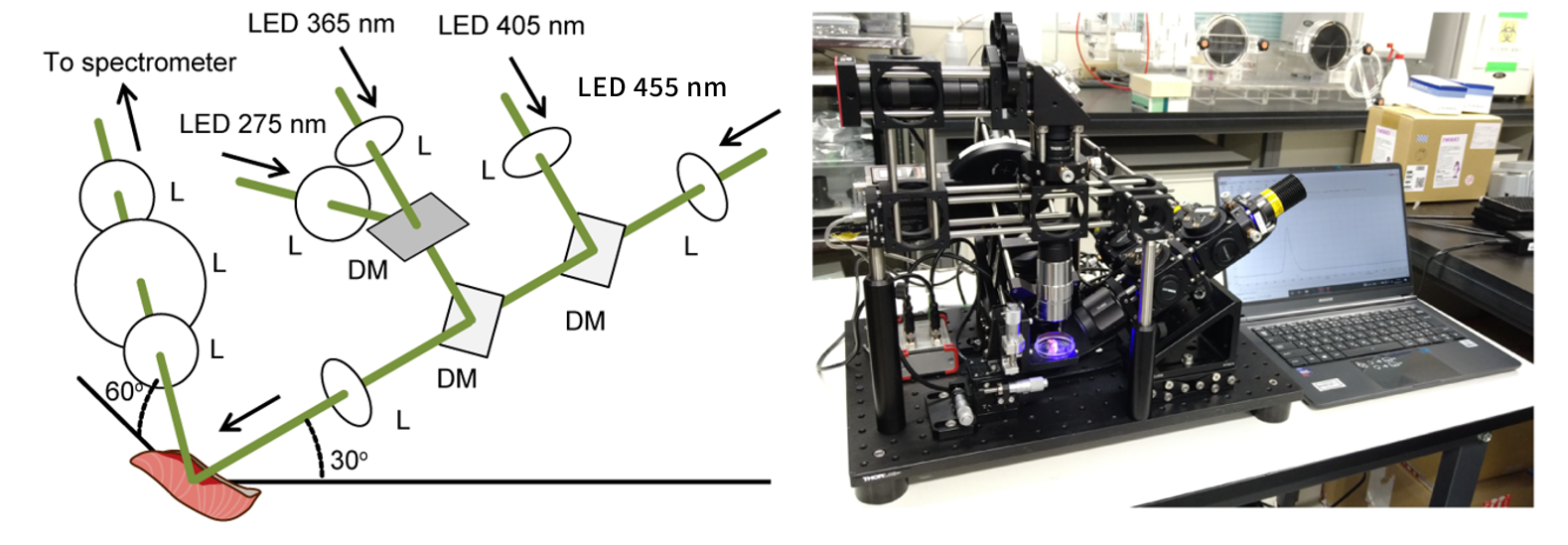
図1.実験模式図(左)と分光計測に用いた自作顕微鏡システム(右)
<関連情報>
- https://www.hiroshima-u.ac.jp/news/92142
- https://www.sciencedirect.com/science/article/abs/pii/S0308814625028286
生食用冷蔵保存中の3種の魚の切り身における自己蛍光スペクトルの比較分析 Comparative analysis of autofluorescence spectra in a filet of three fish species during chilled storage for raw consumption
Kaho Miyazaki, Hideaki Fujita, Kyota Yasuda, Koji Saiki, Tomonobu M. Watanabe
Food Chemistry Available online: 16 July 2025
DOI:https://doi.org/10.1016/j.foodchem.2025.145577
Highlights
- Autofluorescence of chilled salmon, seabream, and amberjack was compared.
- FAD-derived fluorescence indicates oxidation across the three species.
- No fluorescence component directly corresponds to inosinic acid production.
- Inhibition of oxidation caused by astaxanthin was confirmed using autofluorescence.
Abstract
Recent advances in fish freshness evaluation rely on a combination of optical imaging and artificial intelligence due to their applicability to non-invasive and non-destructive measurements. Using trout salmon, red sea bream, and Japanese amberjack, we investigated the feasibility of using autofluorescence spectroscopy, influenced by biochemical reactions, to assess the freshness of fish filets. Spectral analyses using principal component analysis and curve-fitting revealed considerable differences among species. No common spectral changes were associated with the production of inosine monophosphate (IMP), a known freshness indicator. However, fluorescence attributed to flavin adenine dinucleotide oxidation emerged as a potential universal indicator of oxidative state across species, with the largest increase observed in Japanese amberjack, which lacks astaxanthin. These findings suggest that change in autofluorescence spectra reflects oxidative progression during storage but does not correlate with IMP production. Therefore, autofluorescence can reflect the oxidative status but is not suitable for regressive prediction of IMP production.