
2025-08-01 中国科学院(CAS)
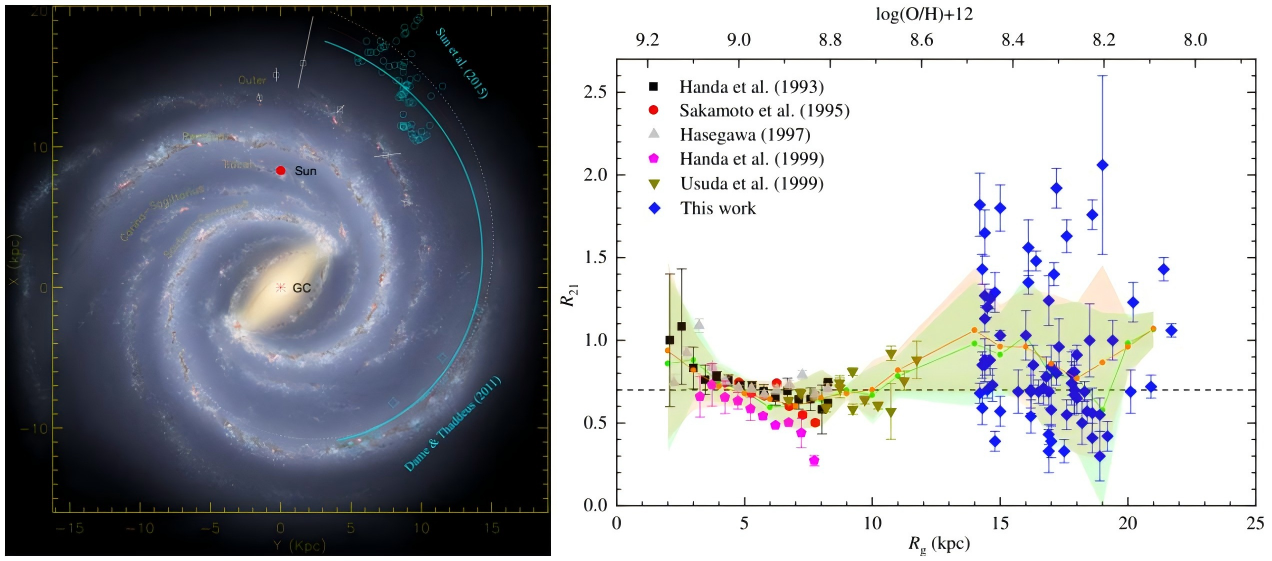
Left: Distribution of molecular clouds (cyan circles) at Galactic edge; Right: Variation of the R21 ratio with the Galactocentric distance. (Image by XAO)
<関連情報>
- https://english.cas.cn/newsroom/research_news/phys/202508/t20250801_1048956.shtml
- https://www.aanda.org/articles/aa/full_html/2025/06/aa53007-24/aa53007-24.html
銀河の縁にある分子雲 I. CO J = 2–1/1–0線の比の変動 Molecular clouds at the edge of the Galaxy I. Variation in the CO J = 2–1/1–0 line ratio
C. S. Luo, X. D. Tang, C. Henkel, K. M. Menten, Y. Sun, Y. Gong, X. W. Zheng, D. L. Li, Y. X. He, X. Lu, Y. P. Ao, X. P. Chen, T. Liu, K. Wang, J. W. Wu, J. Esimbek, J. J. Zhou, J. J. Qiu, X. Zhao, J. S. Li, Q. Zhao, and L. D. Liu
Astronomy & Astrophysics Published:03 June 2025
DOI:https://doi.org/10.1051/0004-6361/202453007
Abstract
The Galactic edge, at Galactocentric distances of 14–22 kpc, provides an ideal laboratory for studying molecular clouds in an environ-ment that is different from the solar neighborhood, due to its lower gas density, lower metallicity, and little or no perturbation from the spiral arms. Observations of CO(J = 2–1) spectral lines were carried out toward 72 molecular clouds located at the Galactic edge using the IRAM 30 m telescope. With these observations combined with CO(J = 1–0) data from the MWISP project, we investigated the variations in R21 across these Galactic edge clouds, with R21 representing CO(2–1)/CO(1–0) integrated intensity ratios. They are found to range from 0.3 to 3.0 with a mean of 1.0 ± 0.1 in the Galactic edge clouds. The proportions of very low-ratio gas (R21 < 0.4), low-ratio gas (0.4 ≤ R21 < 0.7), high-ratio gas (HRG; 0.7 ≤ R21 < 1.0), and very high-ratio gas (VHRG; R21 ≥ 1.0) are 6.9%, 29.2%, 26.4%, and 37.5%, respectively, indicating a significant presence of high R21 ratio molecular gas within these regions. In our Galaxy, the gradient of the R21 ratio exhibits an initial radial decline followed by a high dispersion with increasing Galactocentric distance and a prevalence for VHRG. There is no apparent systematic variation within the Galactocentric distance range of 14 to 22 kpc. A substantial proportion of HRG and VHRG is found to be associated with compact clouds and regions of star-forming activity, suggesting that the high R21 ratios stem from dense gas concentrations and recent episodes of star formation.

