2025-08-06 早稲田大学
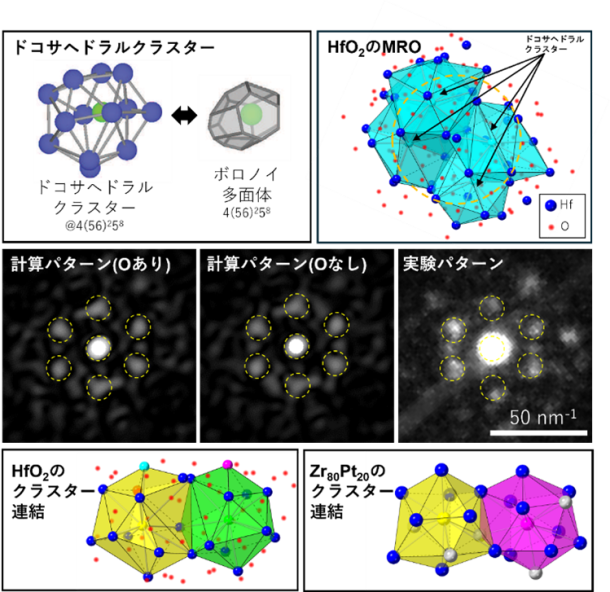
図1 HfO2アモルファス金属酸化物中で観察されたドコサヘドラルクラスターから成る局所原子配列
<関連情報>
非晶質材料の根本的な構造的類似性の証拠 Evidence of underlying structural similarities of amorphous materials
Akihiko Hirata,Kengo Nishio,Masayuki Okugawa & Ryusuke Nakamura
Communications Materials Published:29 July 2025
DOI:https://doi.org/10.1038/s43246-025-00894-0
Abstract
Amorphous metal oxides are generally thought to be structurally different from metallic glasses because of the different types of bonding, such as ionic, metallic, and covalent. While amorphous metal oxides consist of metal atoms surrounded by oxygen atoms, metallic glasses resemble the dense random packing (DRP) of hard spheres. However, a theory suggests that the two different classes of materials have underlying structural similarities. Here, using angstrom-beam electron diffraction (ABED) and the polyhedron code, we provide experimental support for the theory by presenting evidence that the Hf sublattice in amorphous HfO2 contains atomic clusters dominated by pentagonal bipyramids, DRP’s key structural feature. We further observed remarkable similarities between the Hf sublattice and Zr80Pt20 metallic glass, together with distinct differences from amorphous Si and SiO2, which have open tetrahedral-bond-network structures. These findings pave the way for a deeper understanding of the universality of glass structures and their connection to material properties.