2025-07-25 ウィスコンシン大学マディソン校 (UW-Madison)
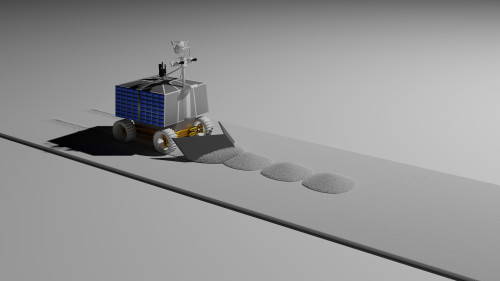
A rover’s operation is simulated in Project Chrono, an open-source physics simulation engine developed at UW–Madison. Image courtesy of Dan Negrut
<関連情報>
- https://news.wisc.edu/robotic-space-rovers-keep-getting-stuck-uw-engineers-have-figured-out-why/
- https://onlinelibrary.wiley.com/doi/10.1002/rob.22597
重力オフセットを利用して宇宙移動ミッションを準備する手法が誤導的であることを示す研究 A Study Demonstrating That Using Gravitational Offset to Prepare Extraterrestrial Mobility Missions Is Misleading
Wei Hu, Pei Li, Arno Rogg, Alexander Schepelmann, Samuel Chandler, Ken Kamrin, Dan Negrut
Journal of Field Robotics Published: 27 May 2025
DOI:https://doi.org/10.1002/rob.22597
ABSTRACT
Recently, there has been a surge of international interest in extraterrestrial exploration targeting the Moon, Mars, the moons of Mars, and various asteroids. This contribution discusses how current state-of-the-art Earth-based testing for designing rovers and landers for these missions currently leads to overly optimistic conclusions about the behavior of these devices upon deployment on the targeted celestial bodies. The key misconception is that gravitational offset is necessary during the terramechanics testing of rover and lander prototypes on Earth. The body of evidence supporting our argument is tied to a small number of studies conducted during parabolic flights and insights derived from newly revised scaling laws. We argue that what has prevented the community from fully diagnosing the problem at hand is the absence of effective physics-based models capable of simulating terramechanics under low-gravity conditions. We developed such a physics-based simulator and utilized it to gauge the mobility of early prototypes of the Volatiles Investigating Polar Exploration Rover. This contribution discusses the results generated by this simulator, how they correlate with physical test results from the NASA-Glenn SLOPE lab, and the fallacy of the gravitational offset in rover and lander testing. The simulator, which is open-source and publicly available, also supports studies for in situ resource utilization activities, for example, digging, bulldozing, and berming, in low-gravity environments.