2025-07-24 ウィスコンシン大学マディソン校(UW–Madison)
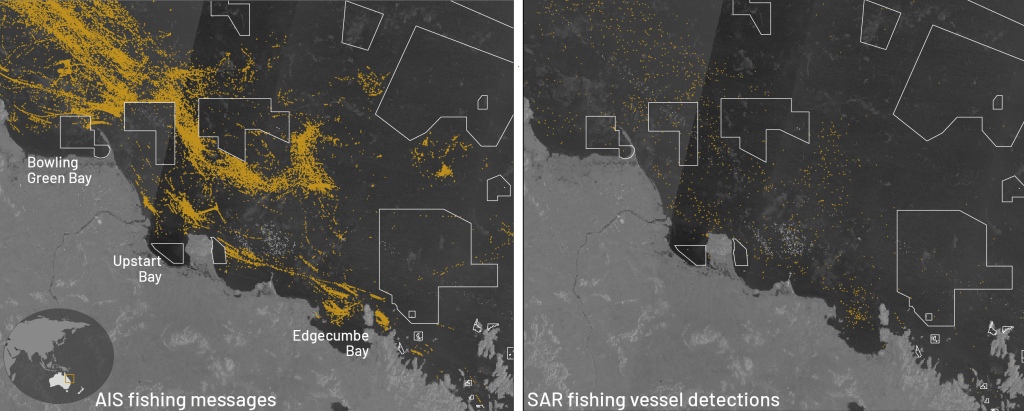
This illustration shows a side-by-side comparison of fishing vessel data detected via AIS and those detected by SAR techniques. Illustration provided by Jennifer Raynor
<関連情報>
- https://news.wisc.edu/satellites-show-that-strictly-protected-marine-areas-exclude-industrial-fishing/
- https://www.science.org/doi/10.1126/science.adt9009
- https://www.nature.com/articles/s41586-023-06825-8
- https://www.science.org/doi/10.1126/science.abn0098
完全保護および高度保護海洋区域では、産業漁業はほとんどまたは全く行われていない Little-to-no industrial fishing occurs in fully and highly protected marine areas
Jennifer Raynor, Sara Orofino, Christopher Costello, Gavin McDonald, […] , and Enric Sala
Science Published:24 Jul 2025
DOI:https://doi.org/10.1126/science.adt9009
Editor’s summary
Marine protected areas (MPAs) are increasingly being established to protect marine ecosystems, in particular fish populations. However, these areas vary in the established level of protection, from complete prohibition of fishing and other uses to limiting these activities. It is also unclear to what degree these regions actually achieve the stated protection levels. In a pair of papers, authors using relatively similar data and approaches reveal seemingly contrary results. Seguin et al. found a continued unauthorized presence of fishing vessels in MPAs of all protection levels. By contrast, Raynor et al. found very little vessel activity in MPAs with the stricter protections. The authors discuss possible drivers underlying the differences (see the Perspective by Worm). —Sacha Vignieri
Abstract
There is a widespread perception that illegal fishing is common in marine protected areas (MPAs) due to strong incentives for poaching and the high cost of monitoring and enforcement. Using artificial intelligence and satellite-based Earth observations, we provide estimates of industrial fishing activity in fully and highly protected MPAs worldwide, in which such fishing is banned. We find little to no activity in most cases. On average, these MPAs had just one fishing vessel present per 20,000 square kilometers during the satellite overpass, a density nine times lower than that of the unprotected waters of exclusive economic zones.
衛星地図は、海上の広範な産業活動を明らかにしています Satellite mapping reveals extensive industrial activity at sea
Fernando S. Paolo,David Kroodsma,Jennifer Raynor,Tim Hochberg,Pete Davis,Jesse Cleary,Luca Marsaglia,Sara Orofino,Christian Thomas & Patrick Halpin
Nature Published:03 January 2024
DOI:https://doi.org/10.1038/s41586-023-06825-8
An Author Correction to this article was published on 02 February 2024
This article has been updated
Abstract
The world’s population increasingly relies on the ocean for food, energy production and global trade1,2,3, yet human activities at sea are not well quantified4,5. We combine satellite imagery, vessel GPS data and deep-learning models to map industrial vessel activities and offshore energy infrastructure across the world’s coastal waters from 2017 to 2021. We find that 72–76% of the world’s industrial fishing vessels are not publicly tracked, with much of that fishing taking place around South Asia, Southeast Asia and Africa. We also find that 21–30% of transport and energy vessel activity is missing from public tracking systems. Globally, fishing decreased by 12 ± 1% at the onset of the COVID-19 pandemic in 2020 and had not recovered to pre-pandemic levels by 2021. By contrast, transport and energy vessel activities were relatively unaffected during the same period. Offshore wind is growing rapidly, with most wind turbines confined to small areas of the ocean but surpassing the number of oil structures in 2021. Our map of ocean industrialization reveals changes in some of the most extensive and economically important human activities at sea.
世界最大の完全保護海洋保護区(MPA)からの spillover 効果 Spillover benefits from the world’s largest fully protected MPA
Sarah Medoff, John Lynham, and Jennifer Raynor
Science Published:20 Oct 2022
DOI:https://doi.org/10.1126/science.abn0098
Does the trick
Marine protected areas (MPAs) have been shown to protect local populations of fishes. Questions have remained, however, about whether they would also work to protect species that migrate or travel over large distances. Medoff et al. looked at the effectiveness of a recently established—and thus far the largest—fully protected MPA located near Hawai’i, and found clear evidence that the protections afforded to two migratory species, bigeye and yellowfin tuna, led to spillover effects previously only seen for resident fish populations. —SNV
Abstract
Previous research has cast doubt on the potential for marine protected areas (MPAs) to provide refuge and fishery spillover benefits for migratory species as most MPAs are small relative to the geographic range of these species. We test for evidence of spillover benefits accruing from the world’s largest fully protected MPA, Papahānaumokuākea Marine National Monument. Using species-specific data collected by independent fishery observers, we examine changes in catch rates for individual vessels near to and far from the MPA before and after its expansion in 2016. We find evidence of spillover benefits for yellowfin (Thunnus albacares) and bigeye tuna (Thunnus obesus).