

2025-07-04 中国科学院(CAS)
<関連情報>
- https://english.cas.cn/newsroom/cas_media/202507/t20250704_1046868.shtml
- https://essd.copernicus.org/articles/17/2933/2025/
1988年から2021年までのチベット高原の年間30m耕作牧草地データセット An annual 30 m cultivated-pasture dataset of the Tibetan Plateau from 1988 to 2021
Binghong Han, Jian Bi, Shengli Tao, Tong Yang, Yongli Tang, Mengshuai Ge, Hao Wang, Zhenong Jin, Jinwei Dong, Zhibiao Nan, and Jin-Sheng He
Earth System Science Data Published:27 Jun 2025
DOI:https://doi.org/10.5194/essd-17-2933-2025
Abstract
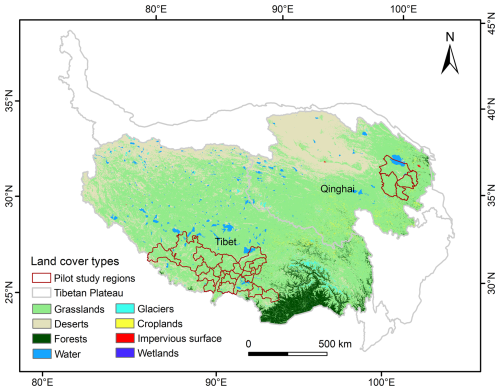
Cultivated pastures have rapidly developed across the Tibetan Plateau over the past several decades, raising concerns about grassland degradation. Accordingly, considerable attention is paid to the protection of Tibetan grassland ecosystems. However, high-resolution spatial distribution of cultivated pastures on the Tibetan Plateau remains poorly understood, primarily due to the difficulty in discriminating cultivated pastures from other land cover types using remote sensing techniques. The absence of such information hinders efficient agricultural and livestock husbandry management, making it challenging to support ecological protection and restoration efforts. Here, we mapped the cultivated pastures on the Tibetan Plateau at a 30 m resolution for the years 1988 to 2021 using Landsat data from the Google Earth Engine (GEE) cloud computing platform. We built a random forest (RF) binary classification model with inputs of the spectral–temporal metrics of Landsat data acquired in the growing season, as well as ancillary topographic data. The model was trained using carefully selected training samples and was validated against 2000 independent random reference points in two pilot study regions with different climates and landscapes. The model achieved an overall accuracy of 97.05 % ± 0.4 % and an F1 spatial consistency score of 82.51 % ± 14.22 % (precision: 90.04 % ± 6.18 %; recall: 76.74 % ± 9.91 %), suggesting high confidence in mapping the distribution of cultivated pastures on the plateau. Using the RF model, we then produced a dataset of cultivated-pasture maps for the years from 1988 to 2021 for Qinghai Province and the Tibet Autonomous Region on the Tibetan Plateau, covering 77 % of the plateau. At both the province and county levels, the cultivated-pasture areas estimated in this study matched well with government statistics for recent years. The area of cultivated pastures on the Tibetan Plateau experienced a significant expansion from 0.46 Mha in 1988 to 1.57 Mha in 2021, with an average annual growth of 33.5±2.5 Kha. To our knowledge, we are the first to map cultivated pastures on the Tibetan Plateau, and our RF binary classification approach holds promise in identifying cultivated pastures in other regions of the world, which could prove to be invaluable for scientists, policymakers, ecological conservation practitioners, and herdspeople. The dataset is available on Zenodo at https://doi.org/10.5281/zenodo.14271782 (Han et al., 2024).

