2025-06-05 NASA
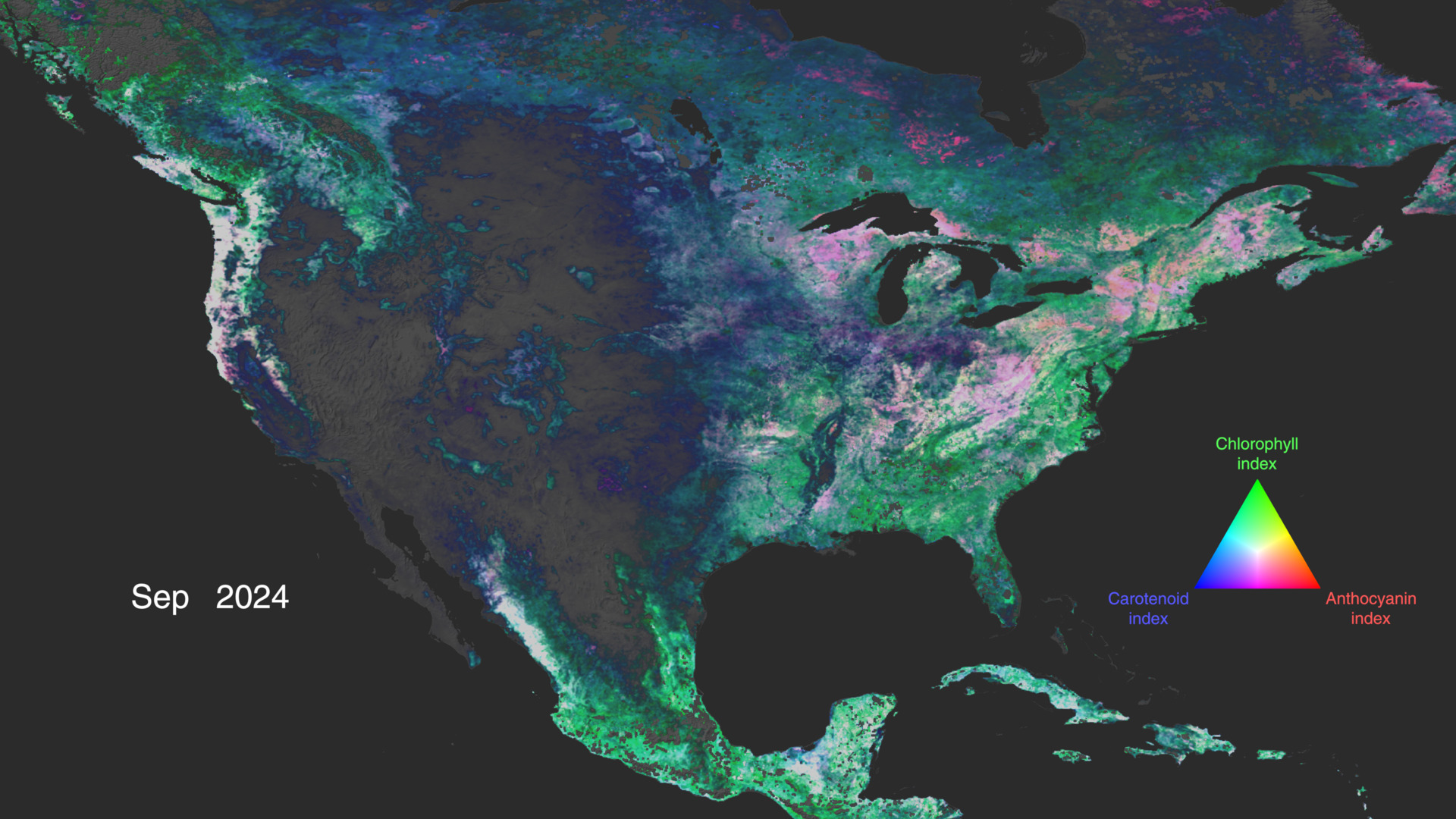 Anthocyanins, carotenoids, and chlorophyll data light up North America, highlighting vegetation and its health. For the full visualization, visit: https://svs.gsfc.nasa.gov/5548/ Credit: NASA’s Scientific Visualization Studio
NASAの地球観測衛星「PACE(Plankton, Aerosol, Cloud, ocean Ecosystem)」ミッションは、2024年2月の打ち上げ以来、1年間にわたり地球の植物の健康状態を観測し、その成果を発表しました。
PACEは、海洋の植物プランクトンや大気中のエアロゾル、雲などの観測に加え、陸上の植生の健康状態も詳細に捉えることが可能です。特に、森林火災後の植生の回復状況や、植物の色の変化を通じてストレス状態を把握することができます。これにより、地球規模での植生の変化や炭素循環の理解が深まります。PACEの観測データは、気候変動の影響を受ける生態系の変化を追跡し、持続可能な農業や森林管理、気候変動対策の立案に貢献することが期待されています。
<関連情報>
- https://www.nasa.gov/earth/nasas-pace-mission-reveals-a-year-of-terrestrial-data-on-plant-health/
- https://www.tandfonline.com/doi/full/10.1080/2150704X.2025.2470905#d1e162
PACE OCIのハイパースペクトル地上データ製品を公開 Unveiling PACE OCI’s hyperspectral terrestrial data products
Skye Caplan & K. Fred Huemmrich
Remote Sensing Letters Published: 27 Feb 2025
DOI:https://doi.org/10.1080/2150704X.2025.2470905
ABSTRACT
Imaging spectroscopy leverages narrow bandwidth radiance measurements to improve observations of Earth’s ecosystems. The Plankton, Aerosol, Cloud, ocean Ecosystem (PACE) mission’s Ocean Color Instrument (OCI) uses global, hyperspectral data to study not only the ocean but also the land surface at ~1.2 km spatial resolution on a one- to two-day timescale. There are two PACE products immediately relevant to terrestrial science: the first is a suite of atmospherically corrected surface reflectances at 50+ OCI bands, resolving spectral properties of the Earth more finely than previous multispectral missions. The second is a suite of ten vegetation indices, six of which are well-known heritage indices requiring only broadband reflectances to be calculated. The remaining four indices depend on narrow-wavelength measurements and are being produced for the first time globally with PACE OCI. These indices have been shown to relate to green vegetation amount, foliar pigments (chlorophylls, carotenoids, and anthocyanins), water content, photosynthetic light use efficiency, and snow cover. Data from the early months of the mission show OCI’s viability for terrestrial investigations – the instrument maintains and extends the historical multispectral data record while also generating novel hyperspectral results from which the mechanisms of Earth’s land surface can be further unravelled.