
2025-02-28 ノースウェスタン大学
<関連情報>
- https://news.northwestern.edu/stories/2025/02/cantilever-highly-sensitive-water-testing/
- https://pubs.acs.org/doi/full/10.1021/acsnano.4c17598
転写因子を介在させたマイクロカンチレバーによる超高感度水汚染物質検出 Ultrasensitive Water Contaminant Detection with Transcription Factor Interfaced Microcantilevers
Dilip Kumar Agarwal,Tyler J. Lucci,Jaeyoung K. Jung,Angel Green Samuel,Gajendra S. Shekhawat,Jean-François Gaillard,Julius B. Lucks,and Vinayak P. Dravid
ACS Nano Published February 24, 2025
DOI:https://doi.org/10.1021/acsnano.4c17598
Abstract
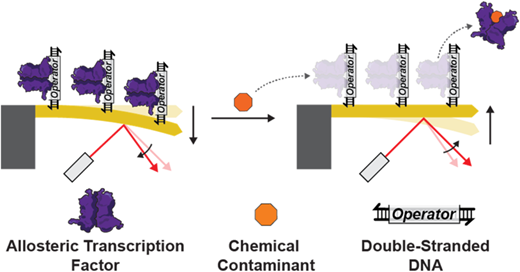
Water contamination by harmful chemicals is a growing global concern, creating a need to develop technologies that can detect a range of target compounds at the required concentrations. Here, we address this need by merging biological allosteric transcription factors with DNA-coated nanomechanical microcantilevers to detect chemicals in water with a digital readout. After proof-of-concept demonstration and optimization to detect anhydrotetracycline with the TetR transcription factor, we use the CadC transcription factor to detect Pb2+ and Cd2+ in water at concentrations down to 2 and 1 ppb, respectively, in less than 15 min. A computational model suggests this improvement in sensitivity could be achieved by the DNA-coated microcantilever surface changing the transcription factor binding properties. Our findings demonstrate a promising approach for water quality monitoring with fast, highly sensitive, digital readout.

