
2026-08-19 カナダ・コンコルディア大学
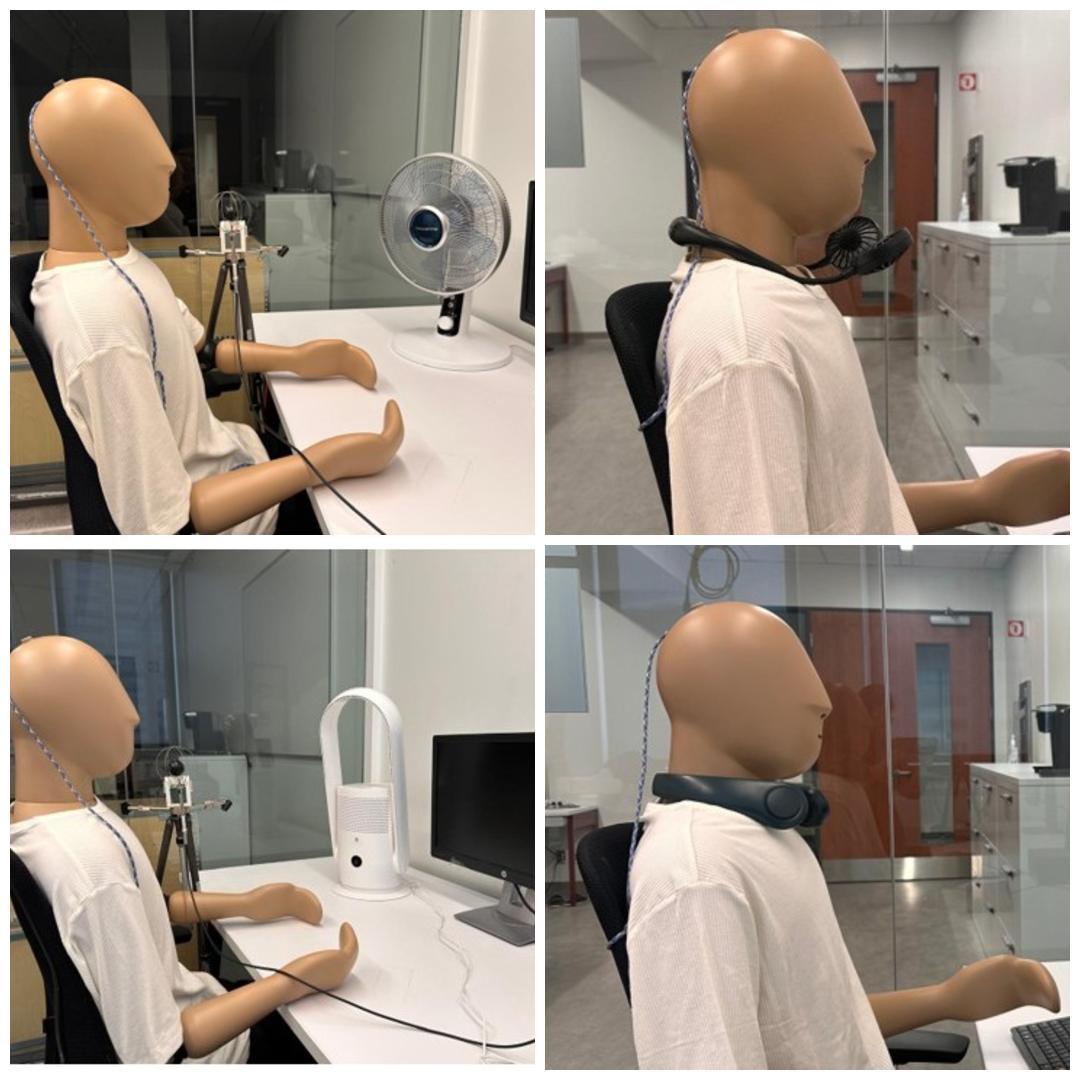
Images courtesy Tazia Rahman
<関連情報>
- https://www.concordia.ca/cunews/ginacody/2026/08/19/research-wearable-fans-could-keep-workers-cool-while-reducing-office-energy-use.html
- https://www.sciengine.com/QKW-E3SWC-E3SWC/doi/10.1051/e3sconf/202671603010
オフィス環境におけるウェアラブル型および非ウェアラブル型パーソナル快適システムの冷却効率の比較 Comparative cooling efficiency of wearable and non-wearable personal comfort systems in office settings
Tazia Rahman, Mohamed M. Ouf, Joyce Kim, Kehinde Bayode
E3S Web of Conferences Available Online: Jun 25, 2026
DOI:https://doi.org/10.1051/e3sconf/202671603010
Abstract
Conventional Personal Comfort System (PCS), such as desk fans (DF), can reduce perceived warmth through elevated air movement but may cause unwanted drafts that disturb nearby occupants. As an alternative, wearable PCS such as face fans (FF) and neck fans (NF) offer targeted cooling with negligible energy consumption. Although the face and neck account for only 5.5% of the body’s surface area, cooling these highly thermosensitive areas has been shown to significantly enhance overall thermal comfort. However, direct comparisons of their cooling efficiency against conventional DF in office settings remain limited. This study compares the cooling effectiveness of wearable PCS (FF and NF) against conventional PCS (bladed and bladeless DF). The evaluation was conducted in a controlled office space with energy-conscious indoor temperature setpoints (25 ± 1 °C, 40 ± 5% RH). A 23-segment adaptive thermal manikin with the JOS-3 thermoregulation model was used to measure local skin temperatures (Tsk), heat flux (P), equivalent temperature (Teq) and predicted mean vote (PMV). Results show that thermal comfort improvements from the wearables closely match the performance of the bladeless DF. Notably, a high-speed FF provided a level of thermal comfort equivalent to that of a low-speed bladed DF (PMV ~0.7). The corrective power in terms of heat loss (CPQ) was significantly improved by the wearable fans, with local heat reductions of up to 7W at the face and 4W at the neck. These findings indicate that targeted breathing-zone cooling can deliver whole-body comfort comparable to cooling from conventional DF, offering a practical, energy-efficient solution for open-plan offices without affecting nearby occupants.

