2026-04-08 名古屋大学
<関連情報>
- https://www.nagoya-u.ac.jp/researchinfo/result/2026/04/x-6.html
- https://www.nagoya-u.ac.jp/researchinfo/result/upload_images/20260408_sci.pdf
- https://iopscience.iop.org/article/10.1088/1538-3873/ae3b74
電鋳X線光学系の開発:シンクロトロン放射光技術と宇宙天文学の架け橋 Development of Electroformed X-Ray Optics Bridging Synchrotron Radiation Technology and Space Astronomy
Ryuto Fujii, Koki Sakuta, Kazuki Ampuku, Yusuke Yoshida, Makoto Yoshihara, Ayumu Takigawa, Keitoku Yoshihira, Tetsuo Kano, Naoki Ishida, Noriyuki Narukage,…
Publications of the Astronomical Society of the Pacific Published: 2026 April 7
DOI:10.1088/1538-3873/ae3b74
Abstract
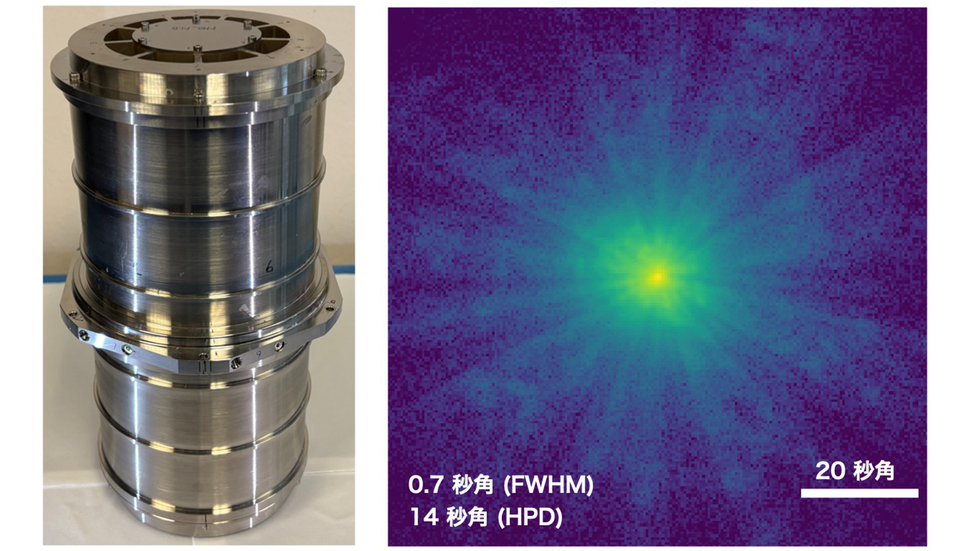
We have developed X-ray telescope mirrors using our original electroforming replication technique, which was established through the fabrication of millimeter-aperture, ultra-short-focal-length nanofocusing mirrors used in synchrotron X-ray microscopy. In this paper, we present for the first time the detailed results of X-ray illumination tests performed both for a 60 mm diameter, full-circumference, double-reflection monolithic electroformed nickel mirror and for the Mirror Module Assembly (MMA) incorporating it. The experiments were performed at SPring-8 beamline BL29XUL, which has a 1 km beamline length. To simulate the parallel X-ray beam from celestial sources, we constructed and utilized a dedicated evaluation system, the High-Brilliance X-ray Kilometer-long Large-Area Expanded-beam Evaluation System (HBX-KLAEES). Thanks to the high photon flux and the virtually point-like source with a very small diverging angle provided by HBX-KLAEES, we were able to evaluate the imaging performance with high fidelity, resolving both the sharp core and the large-angle components of the Point Spread Function. The results demonstrated an extremely sharp core with a Full Width at Half Maximum of 0″.7 and a Half Power Diameter of 14″ even after integration into the MMA. Furthermore, a positive correlation was found between the angular resolution and the axial direction figure error of both the primary and secondary sections, indicating that the axial figure error contributes to image degradation. Based on these achievements, the MMA incorporating this mirror was selected as one of the hard X-ray optics for the FOXSI-4 sounding rocket experiment, which performs high-resolution soft and hard X-ray imaging spectroscopy of solar flares, and was successfully launched. These results pave the way for further improvements in angular resolution and for the development of high-resolution, ultra-short focal length X-ray optics applicable to small satellites including CubeSats.