2026-04-07 自然科学研究機構
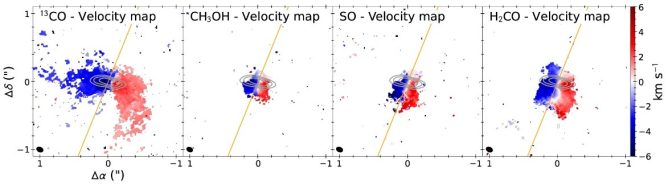
図1:アルマ望遠鏡により異なる分子が出す電波で観測された、生まれたばかりの恒星HPOS 358の周りのガス分布。(クレジット:Kim et al., ALMA (ESO/NAOJ/NRAO))
<関連情報>
- https://alma-telescope.jp/news/mhddiskwinds-202604.html
- https://www.nature.com/articles/s41467-026-71142-3
原始星HOPS 358における回転アウトフローを駆動する磁気流体力学的円盤風の直接的証拠 Direct evidence for magnetohydrodynamic disk winds driving rotating outflows in protostar HOPS 358
Chul-Hwan Kim,Jeong-Eun Lee,Doug Johnstone,Gregory J. Herczeg,Chin-Fei Lee,Logan Francis & Patrick D. Sheehan
Nature Communications Published:06 April 2026
DOI:https://doi.org/10.1038/s41467-026-71142-3
Abstract
Angular momentum removal is a fundamental requirement for star and planet formation, yet the mechanisms driving this process remain debated. Magnetohydrodynamic disk winds, launched along magnetic field lines from extended disk regions, offer a promising solution, particularly in regions where magnetorotational turbulence is weak. Here we present high-resolution Atacama Large Millimeter/submillimeter Array observations of the Class 0 protostar HOPS 358, revealing a rotating, nested outflow structure traced by H2CO, SO, and CH3OH emission. The outflow preserves the disk’s rotational sense and is aligned with the disk axis, providing direct observational evidence for a magnetically launched disk wind. From the measured kinematics, we derive a dimensionless magnetic lever arm of approximately 2.3 and constrain the wind-launching region to radii of 10-18 astronomical units within the planet-forming zone. These results demonstrate that magnetohydrodynamic disk winds operate during the deeply embedded phase, efficiently extracting angular momentum while shaping disk evolution and establishing initial conditions for planet formation.