2026-04-03 東京大学
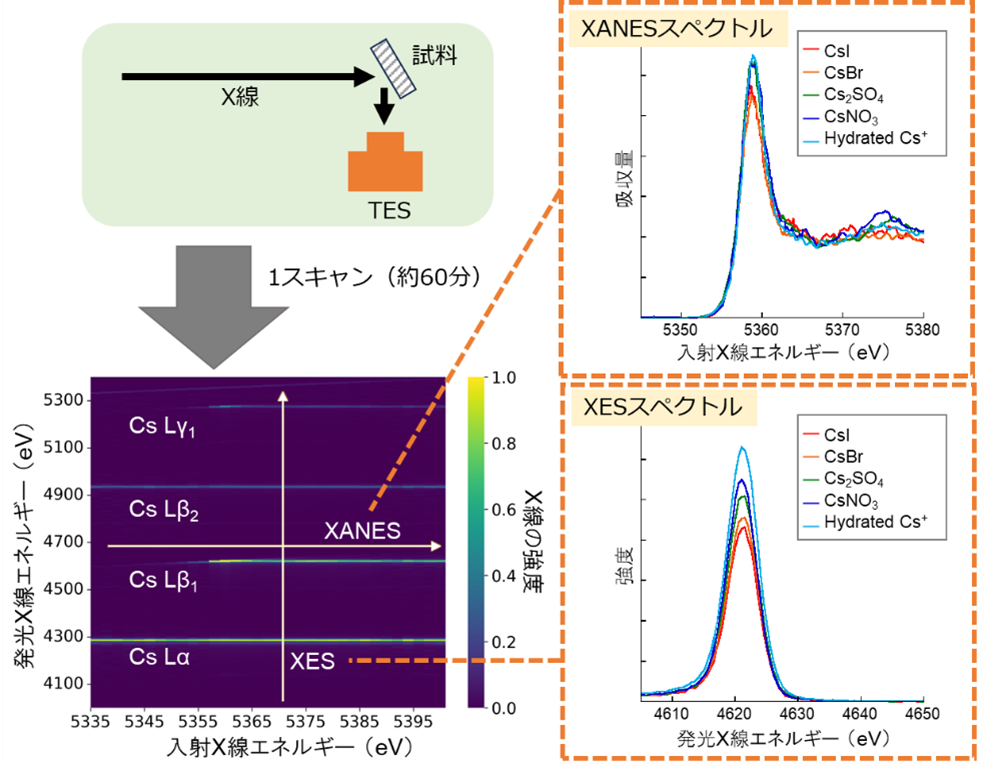
TESを用いた測定の概念図と1回の測定で得られる三次元データ
<関連情報>
- https://www.s.u-tokyo.ac.jp/ja/press/11104/
- https://journals.iucr.org/s/issues/2026/03/00/ok5154/index.html
遷移端センサーを用いたセシウムのHERFD-XANES、RXES、RIXSの同時測定
Simultaneous measurements of HERFD-XANES, RXES and RIXS of caesium using a transition-edge sensor
Akiko Yamaguchi,Shinya Yamada,Tadashi Hashimoto,Takuma Okumura,Yasuo Takeichi,Masahiko Okumura and Yoshio Takahashi
Journal of Synchrotron Radiation Published:3 April 2026
DOI:https://doi.org/10.1107/S1600577526001682
A transition-edge sensor (TES) enables high-resolution measurements of X-ray fluorescence across a wide energy range, allowing for the simultaneous acquisition of high-energy resolution fluorescence-detected X-ray absorption near-edge structure (HERFD-XANES) spectra, resonant X-ray emission spectroscopy (RXES) spectra and resonant inelastic X-ray scattering (RIXS) planes in a single scan. Herein, we employed a TES to investigate various caesium compounds. The results suggest that HERFD-XANES, RXES and RIXS measurements via a TES can effectively reveal detailed information on the chemical states of the target element. This study also compares the performance of the TES with that of a crystal analyzer spectrometer. Although the two techniques differ in achievable energy resolution, the TES provides several distinct advantages, including easier installation, no analyzer exchange, faster measurements and simultaneous detection of multiple emission lines.