2026-04-02 東北大学
<関連情報>
- https://www.tohoku.ac.jp/japanese/2026/04/press20260402-03-phbh.html
- https://www.tohoku.ac.jp/japanese/newimg/pressimg/tohokuuniv-press20260402_03web_phbh.pdf
- https://www.sciencedirect.com/science/article/pii/S0141391026001886
竹-ポリ(3-ヒドロキシブチレート-co-3-ヒドロキシヘキサノエート)複合材料における機械的劣化と生分解の定量的結合:堆肥および水生環境における予測モデリングに向けて Quantitative Coupling Between Mechanical Deterioration and Biodegradation in Bamboo-Poly(3-hydroxybutyrate-co-3-hydroxyhexanoate) Composites: Toward Predictive Modeling Across Compost and Aquatic Environments
Snigdha Das, Lovisa Rova, Zhenjin Wang, Hiroki Kurita, Fumio Narita
Polymer Degradation and Stability Available online 31 March 2026
DOI:https://doi.org/10.1016/j.polymdegradstab.2026.112107

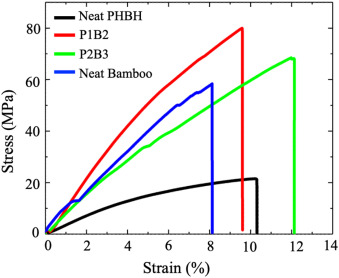
Fig. 4. Stress-strain curve of PHBH, bamboo, and their composites.
Highlights
- The relationship between polymer degradation and tensile-strength deterioration is quantified.
- Degradation behavior is compared across compost, seawater, and tap water environments.
- A rescaled coupling parameter provides mechanistic interpretation of environmental effects.
- Composite architecture governs the apparent kinetics of mechanical degradation.
Abstract
In this study, a green composite was developed by combining sheets of bamboo with the marine-biodegradable polymer poly(3-hydroxybutyrate-co-3-hydroxyhexanoate) (PHBH) via hot compression. The green composites produced were lightweight and biodegradable under different environmental conditions. Mechanical testing showed that the specimen made with two bamboo layers and one PHBH layer had the best performance, reaching an ultimate tensile strength of 71.2 MPa. Young’s modulus and elongation at break also increased significantly compared with those of neat bamboo and PHBH. The composite demonstrated 45% biodegradation after 45 days under controlled composting conditions, and mechanical strength decreased steadily as biodegradation progressed, suggesting a relationship between molecular degradation and mechanical deterioration. In aquatic environments, tensile strength also declined within a few weeks, with the reduction being greater in seawater than in tap water. The composites disintegrated without releasing any hazardous compounds, and no adverse effects on aquatic organisms were observed. A predictive model based on random chain-scission kinetics was used to relate biodegradation to mechanical deterioration quantitatively. A correlation between tensile strength retention and biodegradation degree was established from composting experiments and subsequently used to estimate degradation in seawater and tap water, where direct measurements of degradation were unavailable. Based on this approach, the estimated degradation after 3 weeks was approximately 3.10% in seawater and 1.97% in tap water. The resulting exponential relationship consistently links molecular-scale degradation to macroscopic strength loss across different environments. These results show that bamboo-PHBH composites combine good strength with biodegradability and have potential as sustainable alternatives to conventional plastics for applications in packaging, consumer products, construction, marine applications, biofuels, automotive, and soil amendments.