2026-03-30 テキサス大学オースチン校
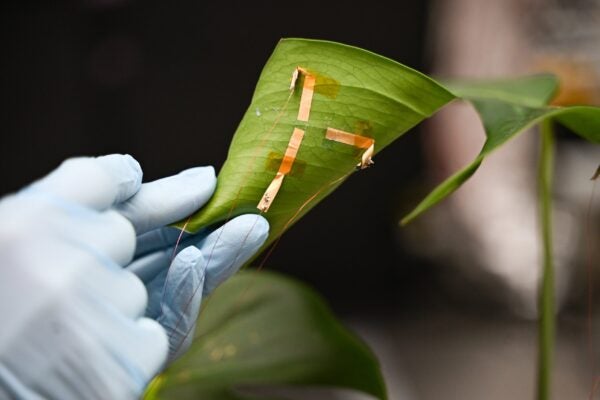
The electronic tattoo uses hyperflexible and sustainable material graphene to track hydration levels.
<関連情報>
- https://news.utexas.edu/2026/03/30/plants-need-water-breakthrough-sensor-measures-leaf-hydration-in-real-time/
- https://pubs.acs.org/doi/10.1021/acs.nanolett.5c05507?ref=pdf
植物の水分状態をモニタリングするためのグラフェン内蔵型センサーコンピューティングデバイス Graphene In-Sensor Compute Device for Plant Hydration Monitoring
Utkarsh Misra,Philip Varkey,Ning Liu,Samuel Liu,Maya Borowicz,Benjamin K. Keitz,Ashley M. Matheny,Dmitry Kireev,Deji Akinwande,and Jean Anne C. Incorvia
Nano Letters Published: February 16, 2026
DOI:https://doi.org/10.1021/acs.nanolett.5c05507
Abstract
Analog sensing devices that exhibit artificial synaptic behavior offer a promising path toward scalable and energy-efficient environmental sensing. In this work, we report graphene-based, leaf-gated in-sensor compute devices for plant hydration monitoring that are capable of both hydration sensing and synapse-like conductance modulation. These devices measure plant water content through trends in channel conductance while simultaneously encoding memory-like states in response to electrical stimulation. Conductance changes track hydration-dependent ion mobility in the leaf with higher (lower) updates in hydrated (dehydrated) states. Devices show linear potentiation and depression and short-term memory retention, supporting their suitability for neuromorphic edge applications. When deployed on Monstera leaves, the devices maintain ultralow power operation (23 aJ/μS write energy/conductance update and 0.23 μW read power) and minimal weight (9 mg) and cause no disruption to plant physiology. By integration of computation and sensing into a single biocompatible platform, this approach minimizes data transmission requirements and enables real-time, long-term hydration monitoring.