2026-03-23 ウィスコンシン大学マディソン校
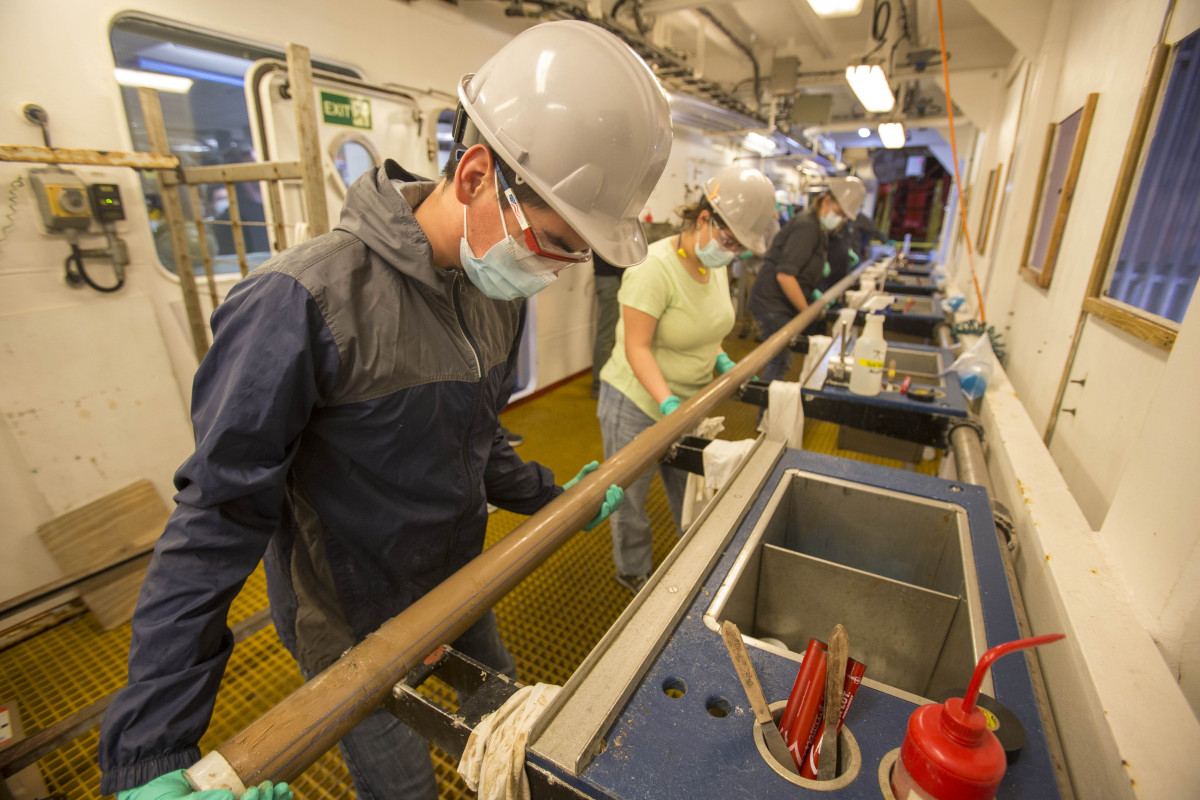
Above left, Oscar Cavazos (Marine Laboratory Specialist, IODP JRSO) joins other marine techs in preparing the core new to be sectioned on the catwalk. Photo Credit: Erick Bravo, IODP JRSO
<関連情報>
- https://news.wisc.edu/ancient-antarctic-ice-cycles-impacted-ocean-productivity-thousands-of-miles-away/
- https://www.pnas.org/doi/10.1073/pnas.2424082123
南極氷床形成初期における高緯度テレコネクションが亜熱帯海洋の生物生産性を促進する High-latitude teleconnections drive subtropical marine bioproductivity at the dawn of the Antarctic ice sheet
Alexandra Villa and Stephen R. Meyers
Proceedings of the National Academy of Sciences Published:March 9, 2026
DOI:https://doi.org/10.1073/pnas.2424082123
Significance
The impact of Antarctic cryosphere dynamics on global marine ecosystems, under the anticipated elevated atmospheric pCO2-levels of our future, is a question of broad societal importance. Newly acquired geologic data from the subtropical South Atlantic provide the first evidence of a highly synchronized 40-kyr-scale teleconnection between Antarctic ice sheet evolution, physical oceanography, and subtropical marine bioproductivity following the Eocene–Oligocene Transition, under pCO2-levels that exceed that of today. This work underscores the sensitivity of the marine-based ice sheets of Antarctica to oceanic heat delivery—with linkages to meridional temperature gradients and pCO2—yielding important implications for marine bioproductivity in our future warming world.
Abstract
The inception of the Antarctic ice sheet (AIS) marked a major global climatic reorganization of the Cenozoic, but the response of the subtropical marine biosphere remains poorly constrained. A new sediment archive from the subtropical South Atlantic (IODP Exp. 390 and 393) reveals a sevenfold increase in surface ocean bioproductivity proxy accumulation (biogenic barium) commensurate with the initial expansion of the AIS 34 Mya, and the emergence of an amplified astronomical forcing of subtropical bioproductivity that mirrors the subsequent evolution of the AIS in the early Oligocene. We find that a strong 40-kyr obliquity response characterizes subtropical bioproductivity following the initial establishment of an expansive marine-based AIS. Portions of the AIS in contact with the marine environment are sensitive to meridional heat delivery controlled by obliquity-forced interactions between the atmosphere and ocean, which can propagate to the lower latitudes via Southern Ocean overturning circulation. The surprising emergence of obliquity forcing of low-latitude bioproductivity enhances our understanding of global teleconnections and feedbacks that regulate global climate, and points to mechanisms driving global marine bioproductivity on astronomical timescales—and their intricate connections to the evolution of the cryosphere.