2026-03-25 マサチューセッツ工科大学(MIT)
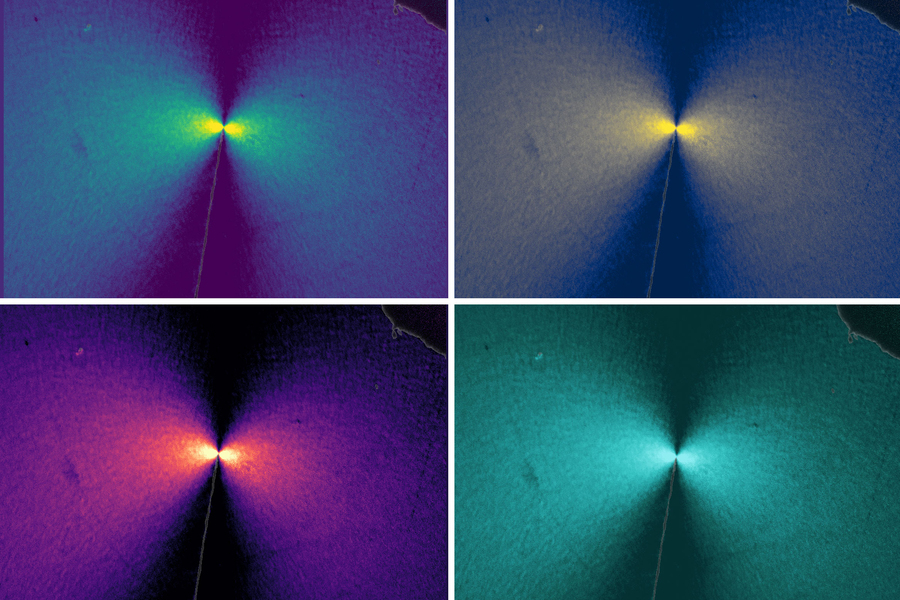
Researchers used a new visual technique to measure stress in a material as a dendrite crack grows. Here, the four graphs have the same data with different color schemes. Brighter colors correspond to higher stress, and a bowtie-shaped pattern can be seen at the crack tip.Credits:Image: Courtesy of the researchers
<関連情報>
- https://news.mit.edu/2026/why-solid-state-batteries-keep-short-circuiting-0325
- https://www.nature.com/articles/s41586-026-10279-z
固体電解質中では、デンドライトの成長に伴って電気化学的腐食が発生する Electrochemical corrosion accompanies dendrite growth in solid electrolytes
Cole D. Fincher,Colin Gilgenbach,Christian Roach,Rachel Osmundsen,Aubrey Penn,Michael D. Thouless,W. Craig Carter,Brian W. Sheldon,James M. LeBeau & Yet-Ming Chiang
Nature Published:25 March 2026
DOI:https://doi.org/10.1038/s41586-026-10279-z
Abstract
Charging rates, cycling performance and safety of solid-state batteries using metal negative electrodes are often limited by dendrites1,2,3, the growth of which depends on coupling between electrochemical and mechanical driving forces. Previously, it has been assumed that dendrites propagate when plating-induced stresses reach the fracture stress of the solid electrolyte. Here we show that dendrites can propagate at far lower stresses. Using operando birefringence microscopy4, we directly measure stresses around growing dendrites in garnet Li6.6La3Zr1.6Ta0.4O12, a highly stable solid electrolyte5,6,7. Plating-induced stresses are present throughout growth and approach the mechanical fracture stress for the slowest-growing dendrites. As current densities and dendrite velocities increase, the stresses accompanying dendrite growth surprisingly decrease, with dendrite propagation occurring at stresses up to 75% lower than under mechanical load alone. Cryogenic scanning transmission electron microscopy (STEM) of dendrites propagated at high current reveals electrolyte decomposition to new phases, associated with which is a net molar volume contraction. The electrochemically induced mode of embrittlement may be mitigated through understanding and control of the nature of phase transitions accompanying instability.