2026-03-26 ドイツ・サステナビリティ研究所(RIFS)
<関連情報>
- https://www.rifs-potsdam.de/en/news/no-climate-neutrality-without-system-change-study-questions-measurement-progress
- https://www.sciencedirect.com/science/article/pii/S2666049026000101
セクター別ゼロカーボン移行における体系的変化を評価するための、シンプルかつ包括的なアプローチ:欧州の電力分野の事例 A simple yet holistic approach for assessing systemic change in sectoral zero-carbon transitions: The case of electricity in Europe
Germán Bersalli, David Gottheit, Johan Lilliestam
Current Research in Environmental Sustainability Available online: 10 March 2026
DOI:https://doi.org/10.1016/j.crsust.2026.100342
Highlights
- Measuring emissions and tech deployment alone can mislead transition progress evaluations.
- Infrastructure and institutional systemic indicators are key to assessing net-zero transitions.
- Sustainability transition literature enables simple but holistic evaluation frameworks useful for policymaking.
- Denmark and Norway lead zero-emission electricity transitions; UK and Germany face bigger systemic transition hurdles.
- Infrastructure development (e.g., grids, storage) remains the biggest challenge.
Abstract
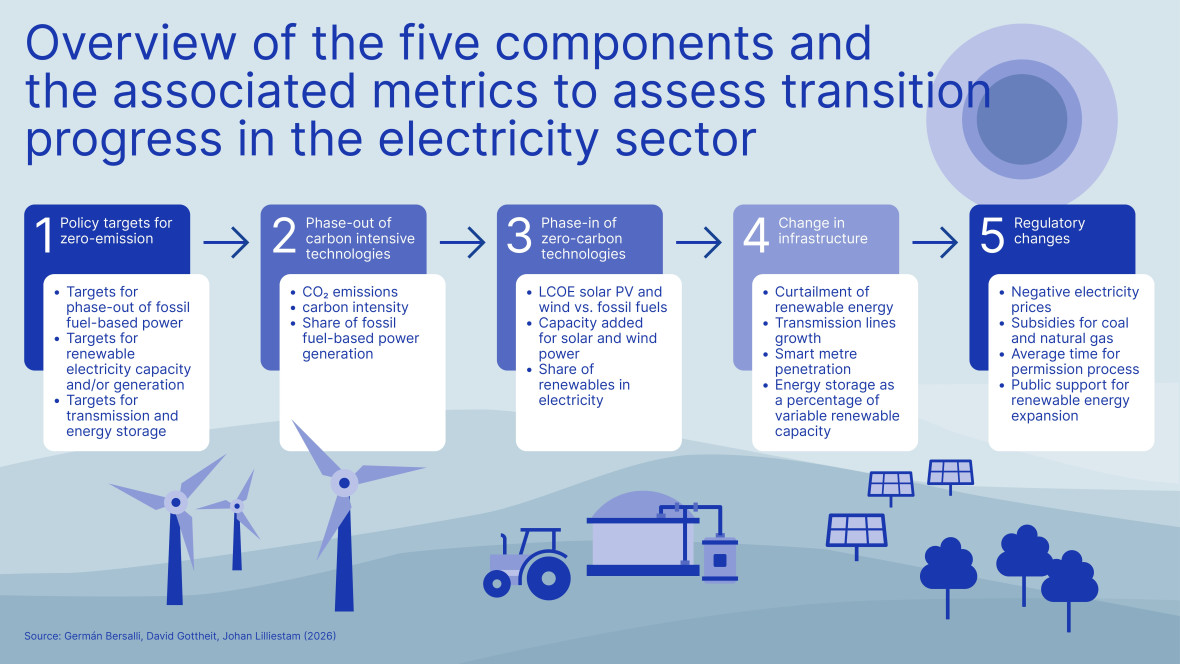
Many countries are seeking to accelerate their transitions to a zero‑carbon energy system in line with their commitments under the Paris Agreement. In energy policy analysis, transition progress and policy success are often measured by trends in emissions and renewable energy deployment. While these outcome metrics are important, they provide limited insight into the broader systemic changes, as they overlook the underlying drivers and processes. Moreover, existing evaluation frameworks often lack theoretical grounding, leading to an incoherent set of indicators. Here, we assess transition progress from a system-change perspective by developing a theory-driven evaluation framework and applying it to the electricity sectors of four European transition “leaders”: the UK, Germany, Denmark, and Norway. Unlike existing frameworks, our approach is rooted in sustainability transitions literature, improving interpretability while maintaining a focused set of systemic change indicators. Our analysis reveals significant progress in scaling up renewables and phasing out carbon-intensive technologies. However, persistent challenges—particularly in electricity grid infrastructure and regulatory adaptation—continue to hinder full decarbonization, especially in the UK and Germany, which are not on track towards zero‑carbon power. The Norwegian and especially Danish electricity transitions are progressing well, not only in terms of emissions and technology deployment, but the underlying systemic measures make their transition policies credible. Our findings highlight the importance of including systemic metrics, going beyond emissions and renewables deployment metrics, and illustrate the feasibility of a “policy turn” in transition studies through forward-looking analytical tools.