2026-03-24 ペンシルベニア州立大学(Penn State)
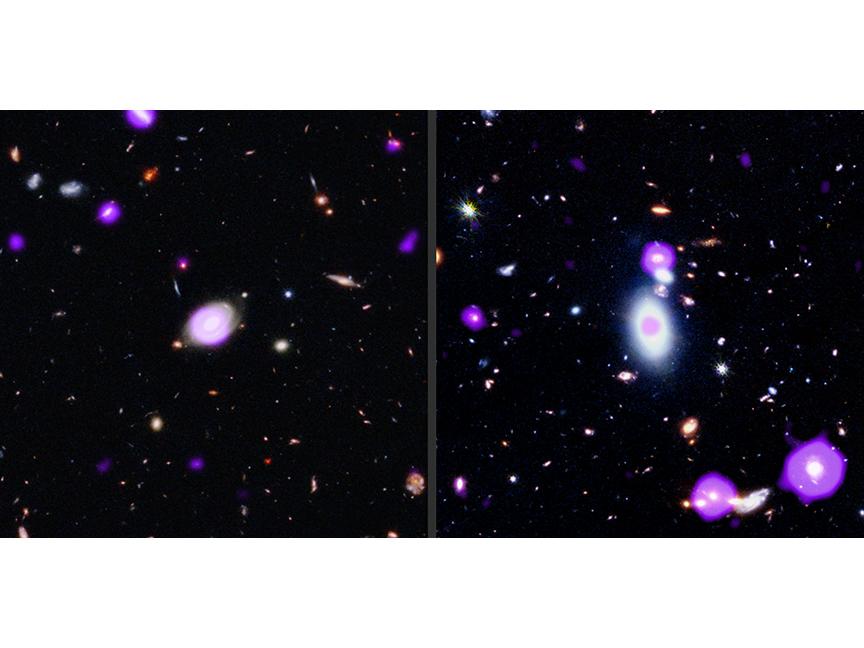
This pair of images represents an extraordinarily large survey of galaxies studying slowdown of the growth of supermassive black holes from about ten billion years ago, when the growth of these black holes was at its peak, to today.
Credit: X-ray: NASA/CXC/Penn State Univ./Z. Yu; Optical (HST): NASA/ESA/STScI; Infrared (JWST): NASA/ESA/CSA/STScI; Image Processing: NASA/CXC/SAO/P. Edmonds and L. Frattare X-ray: NASA/CXC/Penn State Univ./Z. Yu; Optical (HST): NASA/ESA/STScI; Infrared (JWST): N. All Rights Reserved.
<関連情報>
- https://www.psu.edu/news/eberly-college-science/story/supermassive-black-holes-are-growing-slower-because-they-have-less
- https://iopscience.iop.org/article/10.3847/1538-4357/ae173d
z < 2における超大質量ブラックホールの成長低下の要因 The Drivers of the Decline in Supermassive Black Hole Growth at z < 2
Zhibo Yu (喻知博), W. N. Brandt, Fan Zou, Bin Luo, Qingling Ni, D. P. Schneider, and Fabio Vito
The Astrophysical Journal Published: 2025 December 17
DOI:10.3847/1538-4357/ae173d
Abstract
It is well established that cosmic supermassive black hole (SMBH) growth peaks at z ≈ 1.5–2, followed by a strong decline of ≈1–1.5 dex toward the present day, with the comoving number density of higher-luminosity active galactic nuclei (AGNs) peaking at higher redshift (referred to as “AGN downsizing”). We leverage the best current measurements of the SMBH accretion distribution, based upon data from nine well-characterized extragalactic fields with a “wedding-cake” design, to investigate and quantify the drivers of the drastic decline in cosmic SMBH growth. The decline in the typical Eddington ratio (λEdd) of AGNs (decreasing by ≈1.35 dex from z ≈ 1.5–2 to z ≈ 0.2) is the dominant driver for the broad decline in SMBH growth, rather than a shift of accretion activity to less-massive SMBHs. As λEdd decreases toward lower redshift, the primary contributor to the cosmic SMBH accretion density (ρBHAR) has shifted from high-λEdd AGNs to low-λEdd AGNs, even though the latter always dominate the comoving AGN number density at z < 4. We also find that the decline in SMBH growth toward lower SMBH mass in less-massive galaxies is primarily due to the decreasing outburst luminosity rather than the duty cycle.