2026-03-19 シンガポール国立大学(NUS)
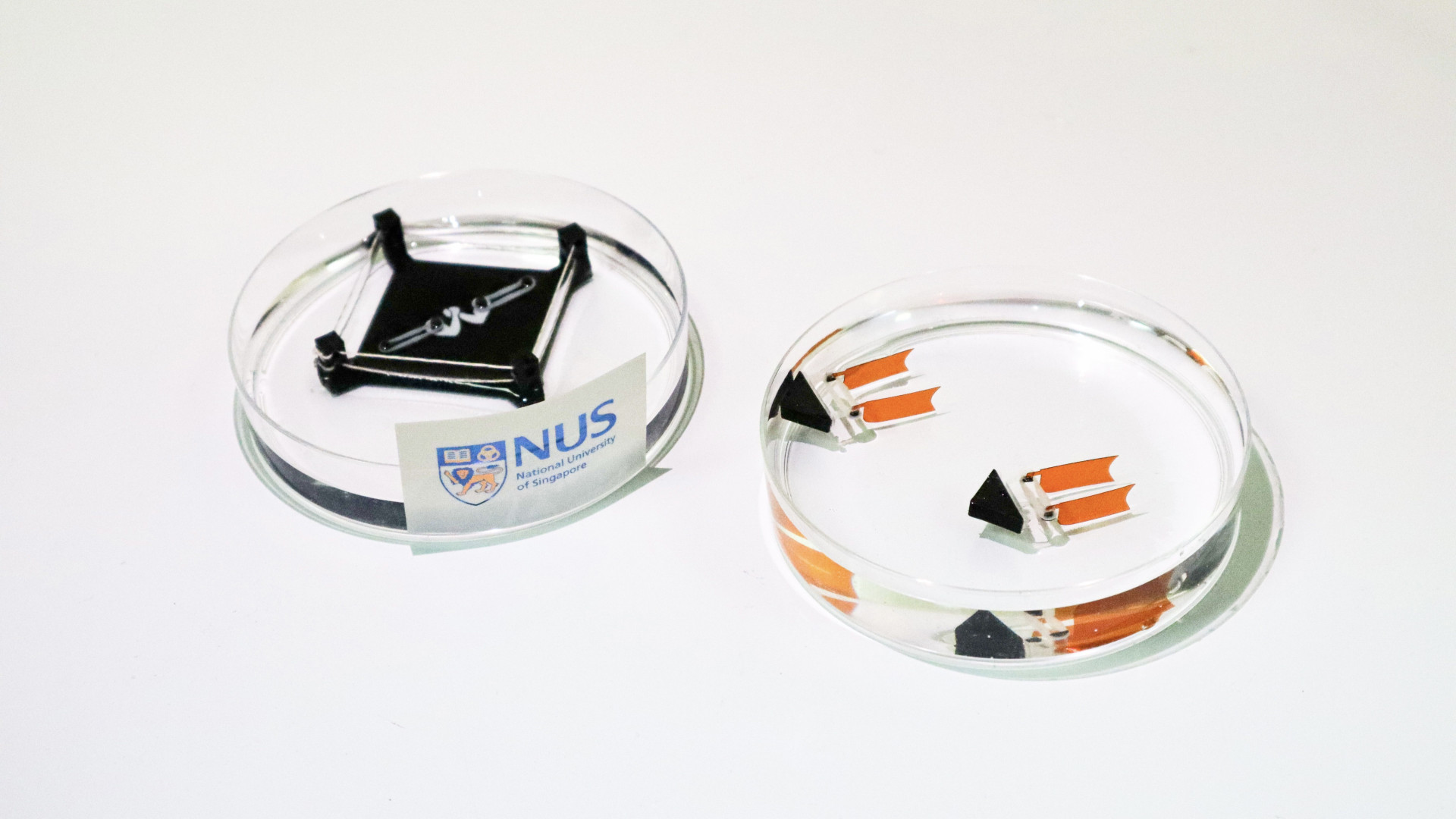
Inspired by arm-wrestling, the NUS team built a self-training platform (left) where two rings of muscle tissues continuously and autonomously pull against each other. OstraBot (right), made from a single trained ring of muscle and two flexible tails, swims 3 times faster than counterparts with conventionally cultured muscle.
<関連情報>
- https://news.nus.edu.sg/what-a-flex-swimming-robot/
- https://www.nature.com/articles/s41467-026-70259-9
自己訓練された高強度筋力を備えた高速遊泳バイオハイブリッドOstraBot Fast-swimming biohybrid OstraBot with self-trained high-strength muscles
Pengyu Chen,Xuchen Wang,Jinrun Zhou & Yu Jun Tan
Nature Communications Published:18 March 2026
DOI:https://doi.org/10.1038/s41467-026-70259-9
Abstract
Limited muscle force generation remains a major bottleneck in developing stronger, faster, and more efficient biohybrid robots. We present a fully autonomous self-training platform that strengthens skeletal muscle tissues by harnessing their robust spontaneous contractions. This approach produced muscle actuators with a maximum force of 7.05 mN and a stress of 8.51 mN/mm2, the highest reported for C2C12-derived muscle actuators. To demonstrate their capabilities, we developed a twin-tail muscle-powered ostraciiform swimming robot, OstraBot, and guided its design using a physiology-based muscle contraction model. Model-informed analysis identified stiffness–frequency combinations that maximized muscle energy output, enabling a top speed of 467 mm/min (15.6 body lengths/min), significantly outperforming previously reported skeletal muscle-powered biohybrid robots. The robot demonstrated strong thrust generation and precise on–off controllability through sound-triggered clapping control. This work establishes a versatile platform for producing high-strength skeletal muscle actuators and quantitatively guiding the robotic design for high-performance biohybrid robots.