2026-03-17 中国科学院(CAS)
<関連情報>
- https://english.cas.cn/newsroom/research-news/202603/t20260318_1152842.shtml
- https://link.springer.com/article/10.1007/s42832-026-0403-x
生態酵素化学量論分析により、熱帯林における微生物代謝のリン制限が標高勾配に沿って増加することが明らかになった Ecoenzymatic stoichiometry reveals increased phosphorus limitation of microbial metabolism in tropical forests along elevation gradients
Luhui Kuang,Zhijian Mou,Yuanwen Kuang,Dexiang Chen,Jun Wang,Dafeng Hui,Hans Lambers,Josep Peñuelas,Jordi Sardans,Hai Ren &Zhanfeng Liu
Soil Ecology Letters
Abstract
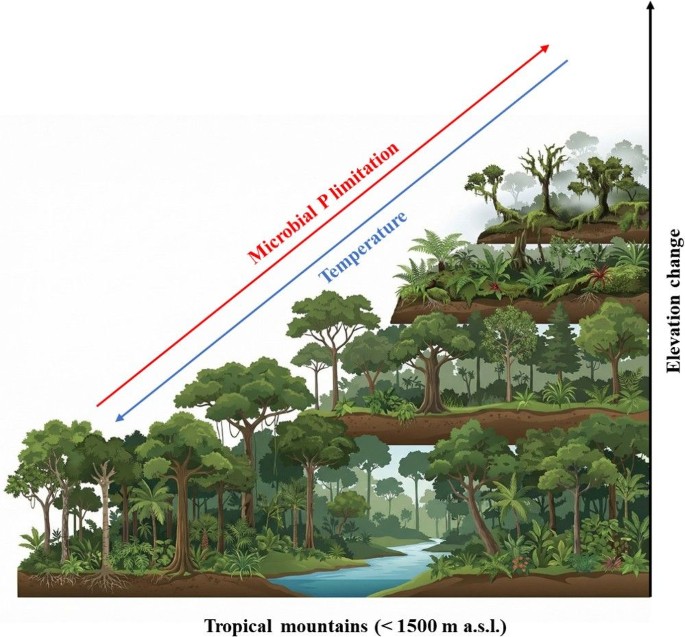
- Soil microorganisms in tropical forests were strongly limited by P and increased with increasing elevation.
- Microbial C limitation was relatively low and lacked a consistent elevational pattern in tropical forest soils.
- Temperature emerged as the most significant predictor of microbial metabolic limitations, showing a positive correlation with microbial C limitation but a negative correlation with microbial P limitation.
Tropical forests exert the largest influence on the global carbon (C) cycle and climate, and soil microorganisms play an essential role in the feedbacks of the global C cycle and climate. However, the issue of how nutrient limitation of microbial metabolism affects the soil C cycle and its responses to climate change in tropical forests remains poorly understood. Here, we investigated the elevational patterns of microbial metabolic limitations in typical tropical forests by studying ecoenzymatic stoichiometry along three elevation gradients (with an overall elevation range of 100–1400 m above sea level (a.s.l.)) in south China. Results showed that microbial metabolism in tropical forest soils was strongly limited by phosphorus (P) and increased with increasing elevation, suggesting that there was greater microbial P limitation where temperatures were lower. In contrast, microbial C limitation was relatively low and did not show a consistent elevational pattern. Temperature emerged as the most significant predictor of microbial metabolic limitations, showing a positive correlation with microbial C limitation but a negative correlation with microbial P limitation. Based on an investigation of three topical forest elevation gradients (< 1500 m a.s.l.), our findings predict that global warming may alleviate microbial P limitation while exacerbate microbial C limitation.