2026-03-18 東北大学
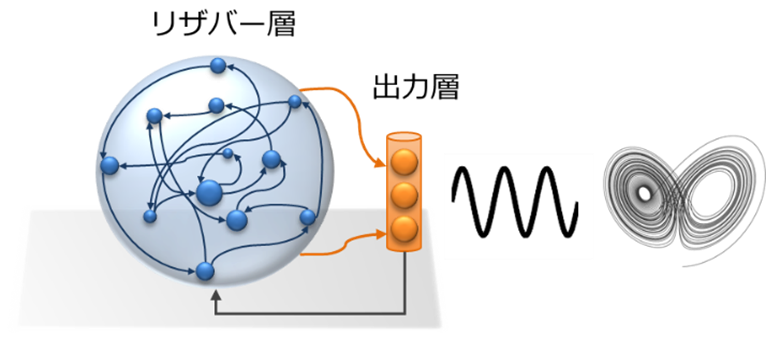
図1. リザバー計算の概念図。リザバー層と出力層を結ぶ結合の重みを学習により最適化することで、所望の信号を出力させる。
<関連情報>
- https://www.tohoku.ac.jp/japanese/2026/03/press20260318-03-neural.html
- https://www.tohoku.ac.jp/japanese/newimg/pressimg/tohokuuniv-press20260318_03web_neural.pdf
- https://www.pnas.org/doi/10.1073/pnas.2521560123
フィードバック制御下における生物学的ニューラルネットワークの時間パターンに関するオンライン教師あり学習 Online supervised learning of temporal patterns in biological neural networks under feedback control
Yuki Sono, Hideaki Yamamoto, Yusei Nishi, +4 , and Shigeo Sato
Proceedings of the National Academy of Sciences Published:March 12, 2026
DOI:https://doi.org/10.1073/pnas.2521560123
Significance
Reservoir computing is a machine learning paradigm that exploits the transient dynamics of high-dimensional nonlinear systems. Although it was originally inspired by the mammalian brain and widely explored in physical systems, its implementations in biological neural networks (BNNs) have been limited due to their excessive connectivity and global synchrony in vitro. Here, we use microfluidic devices to construct modular, nonrandomly connected BNNs and integrate them with microelectrode arrays in a closed-loop reservoir computing environment. We show that the system can be trained to autonomously output various temporal signals, with the modular connectivity that is essential for learning. In vitro BNNs provide unique alternatives for physical reservoirs with dynamic adaptability.
Abstract
In vitro biological neural networks (BNNs) provide well-defined model systems for constructively investigating how living cells interact with their environments to shape high-dimensional dynamics that can be used to generate coherent temporal outputs, such as those required for motor control. Here, we develop a real-time closed-loop BNN system that is capable of generating periodic and chaotic temporal signals by integrating cultured cortical neurons with microfluidic devices and high-density microelectrode arrays. We show that training a simple linear decoder with fixed feedback weights enables the system to learn and autonomously generate diverse temporal patterns. When feedback is switched on, the irregular activity in the BNNs is transformed into low-dimensional, structured dynamics, producing coherent trajectories that are characterized by stable transitions between different neural states. BNNs trained on various target frequencies—ranging from 4 to 30 s—can be trained to sustain oscillations at distinct frequencies, demonstrating their adaptability. Importantly, top–down control of the self-organized network formation with microfluidic devices is the key to suppressing excessive synchronization and increasing dynamic complexity in BNNs, facilitating the training process and the generation of robust outputs. This work offers a biologically inspired platform for understanding the physical basis of cortical computations and for advancing energy-efficient neuromorphic computing paradigms.

![ニトロアレーンとグリニャール反応剤から 多官能ビアリールを⼀段階合成 −ベンジジン型[5,5]-転位を制御する新合成戦略−](https://www.isct.ac.jp/cms/contents/data/1/3510/component/file/6ed43e487467fa6ef840df80b800a080.webp "ニトロアレーンとグリニャール反応剤から 多官能ビアリールを⼀段階合成 −ベンジジン型[5,5]-転位を制御する新合成戦略−")