
2026-03-16 ノースカロライナ州立大学(NC State)
<関連情報>
- https://news.ncsu.edu/2026/03/reevaluating-reaction-rates-to-better-understand-the-stars/
- https://iopscience.iop.org/article/10.3847/1538-4365/ae2bdc
2025年実験的熱核反応率評価(ETR25) The 2025 Evaluation of Experimental Thermonuclear Reaction Rates (ETR25)
Christian Iliadis, Richard Longland, Kiana Setoodehnia, Caleb Marshall, Peter Mohr, and Athanasios Psaltis
The Astrophysical Journal Supplement Series Published: 2026 February 19
DOI:10.3847/1538-4365/ae2bdc
Abstract
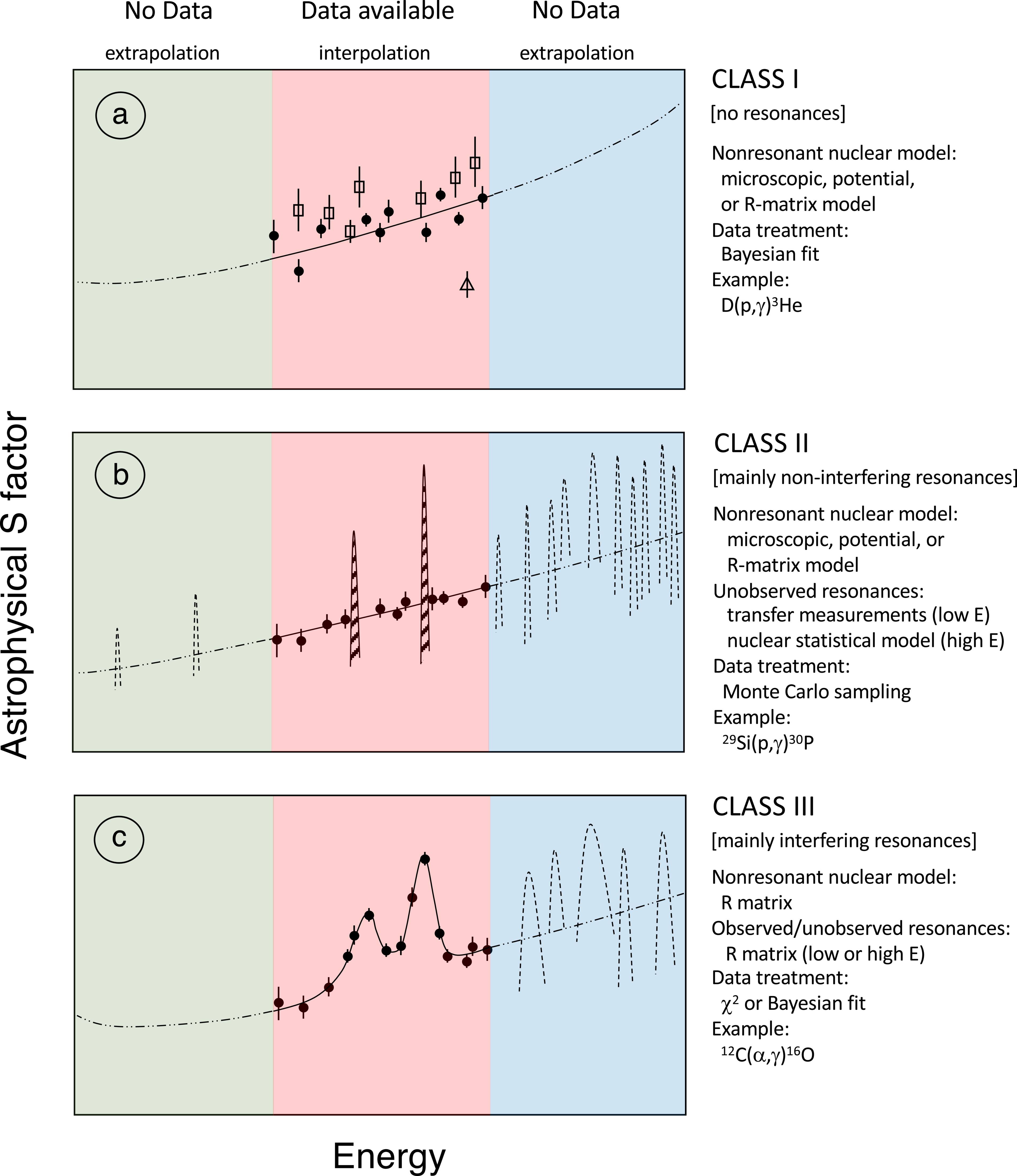
This work describes the formalism for estimating thermonuclear reaction rates for astrophysical applications, emphasizing modern statistical approaches such as Monte Carlo sampling and Bayesian models. We discuss related topics including the calculation of resonance energies from nuclear Q values, indirect estimates of particle partial widths, and matching of reaction rates at elevated temperatures to statistical model results. We have evaluated available experimental data on cross sections, resonance energies and strengths, partial widths, lifetimes, spin-parities, and spectroscopic factors. Based on these results, we have estimated numerical values of 78 experimental charged-particle thermonuclear reaction rates for target nuclei in the A = 2–40 mass region, for temperatures ranging from 1 MK to 10 GK. For each reaction, three rate values are provided: low, median, and high, corresponding to the 16th, 50th, and 84th percentiles, respectively, of the cumulative reaction rate probability density distribution. Additionally, we present the factor uncertainty of each rate at each temperature grid point. These results enable users to sample the reaction rate probability density in nucleosynthesis calculations, facilitating uncertainty estimates of nuclidic abundances. The rates presented here refer to their laboratory values. For use in stellar model simulations, these values need to be corrected for the effects of thermal excitations of the interacting nuclei. For each reaction, we include graphs that illustrate the fractional contributions to the overall reaction rate along with the associated uncertainty. These visuals are designed to assist both stellar modelers and nuclear experimentalists by identifying the primary sources of rate uncertainty at specific stellar temperatures. A graphical comparison with earlier Monte Carlo rates is also provided.


