2026-03-11 中国科学院(CAS)
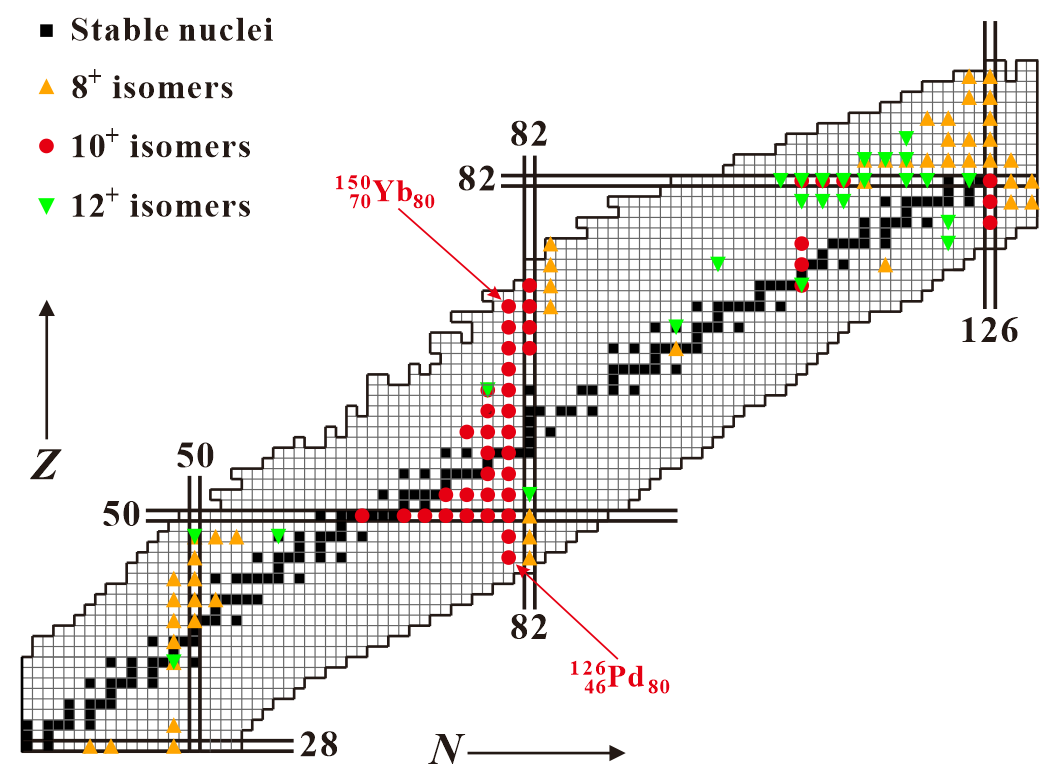
Figure 1. Occurrence of 8+, 10+, and 12+ isomers on the partial nuclear chart. (Image by Physical Review Letters)
<関連情報>
- https://english.cas.cn/newsroom/research-news/202603/t20260312_1152431.shtml
- https://journals.aps.org/prl/abstract/10.1103/6cjc-bhfg
発見=10+異性体150Yb: 最長の性質10+異性体鎖 Discovery of an =10+ Isomer in 150Yb: Nature of the Longest 10+ Isomeric Chain
W. Q. Zhang, Z. Liu, A. N. Andreyev, Y. X. Yu, G. J. Fu, C. Qi, H. Huang, X. H. Yu, P. M. Walker et al.
Physical Review Letters Published: 26 February, 2026
DOI: https://doi.org/10.1103/6cjc-bhfg
Abstract
Delayed -ray spectroscopy was performed for evaporation residues produced in the 58Ni+96Ru reaction. A new isomer in 70150Yb (Z=70, N=80) with a half-life of 0.62(5) μs was identified at an excitation energy of 2872(2) keV. Its spin-parity is assigned as (10+) and a decay scheme is proposed based on a strong analogy with that of the isotonic 68148Er. Previously, the 10+ isomers were observed in the N=80 even- isotones from the neutron-rich 46126Pd to the neutron-deficient 68148Er. For the first time, by combining experimental data and comprehensive large-scale shell-model calculations, we clearly identify the configurations of these isomers and demonstrate that they all exhibit seniority structures. These findings firmly establish a configuration change in the 10+ isomeric chain, from a pair of maximally aligned 1ℎ11/2 neutrons (holes) to a pair of maximally aligned 1ℎ11/2 protons around the Z=64 subshell closure. This transition serves as a unique isomeric relay underpinning the persistence of the isomeric chain.