2026-03-12 東北大学
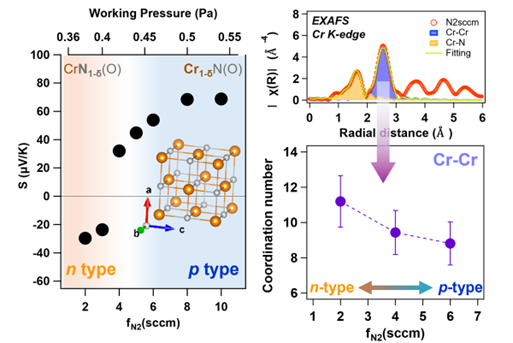
図2. (a) 各fN2で成膜したCrN薄膜のゼーベック係数。(b) 代表例として、fN2 = 2 sccmで成膜したCrN薄膜のCr K吸収端におけるフーリエ変換EXAFSスペクトルおよびフィッティング結果。(c) (b)のフィッティングに基づき算出したCr-Cr経路の配位数(Coordination number)。
<関連情報>
- https://www.tohoku.ac.jp/japanese/2026/03/press20260312-02-p.html
- https://www.tohoku.ac.jp/japanese/newimg/pressimg/tohokuuniv-press20260312_02web_p.pdf
- https://pubs.rsc.org/en/content/articlelanding/2026/ta/d5ta10269c
CrN膜における残留酸素駆動p-n変換と熱電特性 Residual oxygen-driven p–n conversion and thermoelectric properties in CrN films
Yi Shuang,Yuta Saito,Shogo Hatayama,Mihyeon Kim,Paul Fons and Yuji Sutou
Journal of Materials Chemistry A Published:06 Mar 2026
DOI:https://doi.org/10.1039/D5TA10269C
Abstract
Transition metal nitrides such as CrN are promising for thermoelectric applications due to their high stability and tunable electronic properties, yet they have been largely limited to n-type conduction, restricting device design. Here, we report the successful synthesis of p-type CrN films via controlled residual oxygen incorporation during RF magnetron sputtering regulated through N2 gas flow adjustment, without introducing any additional oxygen source. A low N2 gas flow rate (fN2) produces N-deficient CrN1−δ(O) films with n-type conduction dominated by nitrogen vacancies, while higher fN2 (≥4 sccm) stabilizes Cr vacancies in over-stoichiometric Cr1−δN(O) films, resulting in p-type hole conduction. Cr K-edge X-ray absorption fine structure (XAFS) reveals Cr–Cr bond elongation, reduced coordination, and enhanced Cr3d–O/N2p hybridization, indicative of localized hole states. Temperature-dependent transport measurements confirm the mechanisms, leading to a room-temperature power factor (PF) up to 0.105 mW m−1 K−2 (n-type) and 0.053 mW m−1 K−2 (p-type). The structural similarity between the n- and p-type films enables the creation of p–n homojunctions, highlighting a straightforward route for CrN-based thermoelectric devices.