2026-03-10 カリフォルニア大学サンディエゴ校(UCSD)
<関連情報>
- https://today.ucsd.edu/story/new-ai-agent-could-transform-how-scientists-study-weather-and-climate
- https://arxiv.org/abs/2510.04017
- https://arxiv.org/pdf/2510.04017
Zephyrus: 気象科学のためのエージェントフレームワーク Zephyrus: An Agentic Framework for Weather Science
Sumanth Varambally, Marshall Fisher, Jas Thakker, Yiwei Chen, Zhirui Xia, Yasaman Jafari, Ruijia Niu, Manas Jain, Veeramakali Vignesh Manivannan, Zachary Novack, Luyu Han, Srikar Eranky, Salva Rühling Cachay, Taylor Berg-Kirkpatrick, Duncan Watson-Parris, Yi-An Ma, Rose Yu
arXiv Submitted on 5 Oct 2025
DOI:https://doi.org/10.48550/arXiv.2510.04017
Abstract
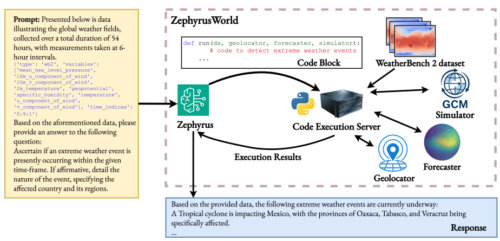
Foundation models for weather science are pre-trained on vast amounts of structured numerical data and outperform traditional weather forecasting systems. However, these models lack language-based reasoning capabilities, limiting their utility in interactive scientific workflows. Large language models (LLMs) excel at understanding and generating text but cannot reason about high-dimensional meteorological datasets. We bridge this gap by building a novel agentic framework for weather science. Our framework includes a Python code-based environment for agents (ZephyrusWorld) to interact with weather data, featuring tools like an interface to WeatherBench 2 dataset, geoquerying for geographical masks from natural language, weather forecasting, and climate simulation capabilities. We design Zephyrus, a multi-turn LLM-based weather agent that iteratively analyzes weather datasets, observes results, and refines its approach through conversational feedback loops. We accompany the agent with a new benchmark, ZephyrusBench, with a scalable data generation pipeline that constructs diverse question-answer pairs across weather-related tasks, from basic lookups to advanced forecasting, extreme event detection, and counterfactual reasoning. Experiments on this benchmark demonstrate the strong performance of Zephyrus agents over text-only baselines, outperforming them by up to 35 percentage points in correctness. However, on harder tasks, Zephyrus performs similarly to text-only baselines, highlighting the challenging nature of our benchmark and suggesting promising directions for future work.