
2026-03-06 東京大学

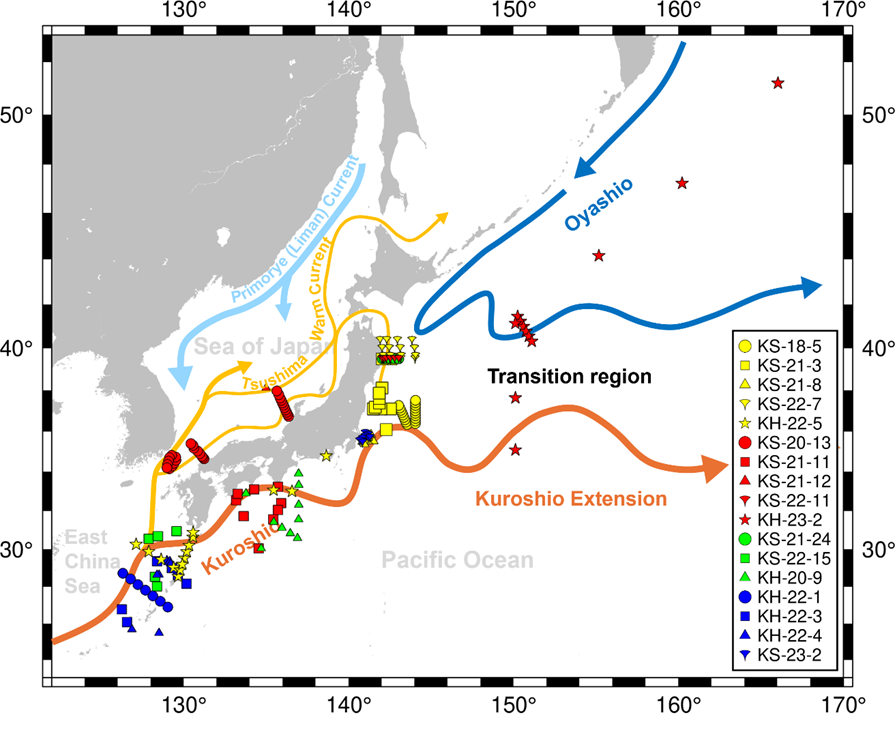
図1:本研究の海水サンプル採集および環境データ観測点
<関連情報>
- https://www.aori.u-tokyo.ac.jp/research/news/2026/20260306.html
- https://www.sciencedirect.com/science/article/pii/S0079661126000194
遷移帯によって生み出される外洋における逆緯度生物多様性勾配:北西太平洋の魚類分布からの知見 Opposite latitudinal biodiversity gradient in the open ocean generated by transition zones: Insights from fish distribution in the Northwest Pacific
Yuan Lin, Zeshu Yu, Sk Istiaque Ahmed, Xueding Wang, Tomihiko Higuchi, Itsuka Yabe, Marty Kwok-Shing Wong, Sachihiko Itoh, Eisuke Tsutsumi, Hiroaki Saito, Kosei Komatsu, Atsushi Tsuda, Yusuke Kawaguchi, Eitarou Oka, Hajime Obata, Yuki Minegishi, Hideki Fukuda, Jun Inoue, Susumu Hyodo, Shin-ichi Ito
Progress in Oceanography Available online: 22 January 2026
DOI:https://doi.org/10.1016/j.pocean.2026.103685
Highlights
- 5-year eDNA data reveals higher fish diversity in cooler region in Northwestern Pacific.
- Diversity pattern opposed to classical latitudinal diversity gradient (LDG) paradigm.
- Higher diversity occurs in coastal–offshore and Kuroshio–Oyashio transition zones.
- These diversity hotspots formed bimodal diversity peaks relative to temperature.
Abstract
In this study, we used five years of environmental DNA (eDNA) data to examine the geographic distribution and community structure of marine fish in the Northwestern Pacific. We identified key environmental drivers influencing fish community composition, focusing on dynamic transition zones such as coastal–offshore interfaces and the Kuroshio–Oyashio transition zone. Using eDNA samples and environmental data from 2018 to 2023, we analyzed fish community structure with high-throughput sequencing. Hierarchical clustering, non-metric multidimensional scaling (NMDS), diversity index estimation, and generalized additive models (GAMs) were employed to evaluate the impact of ecological factors on community composition and diversity patterns. Clustering showed six distinct fish communities based on the presence/absence data. Species accumulation curves indicated highest diversity in the coastal region of the Subtropical Gyre, followed by the East China Sea and the Kuroshio–Oyashio transition zone. NMDS revealed that salinity and seafloor depth strongly influenced community composition, in addition to surface temperature, chlorophyll-a, and dissolved oxygen. GAM results showed that surface temperature, seafloor depth, and vertical temperature gradients primarily drove the spatial variation in species richness, with temperature showing a nonlinear effect. Our findings revealed that fish biodiversity tends to be higher in cooler regions and shallower depths, with biodiversity hotspots occurring in coastal–offshore frontal zones and the Kuroshio–Oyashio transition zone. These hotspots formed bimodal diversity peaks relative to temperature, and a depth-related peak near the continental slope–trench transition. This study supports efforts toward sustainable marine ecosystem development and biodiversity conservation in dynamic oceanic systems.


