2026-03-05 東北大学
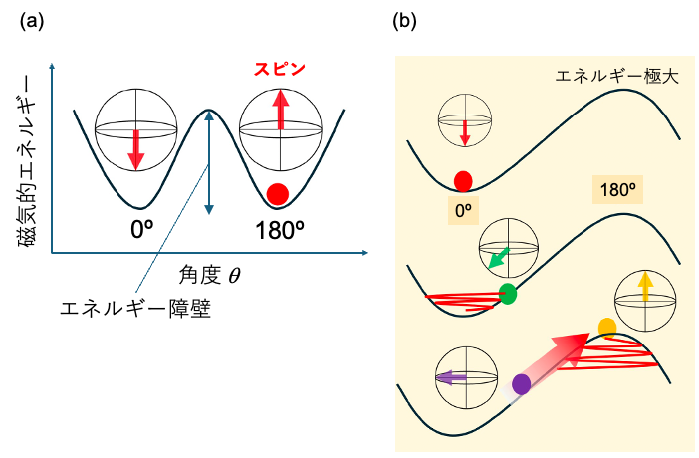
図1. (a) 一軸の磁気異方性を有する磁石のエネルギーの角度依存性の模式図。南極方向からの角度θ が0ºと180ºでエネルギーが極小となり、安定な状態となる。(b) 等方性磁石に外部磁場を印加したときのエネルギーの角度依存性の模式図。
<関連情報>
- https://www.tohoku.ac.jp/japanese/2026/03/press20260305-01-spin.html
- https://www.tohoku.ac.jp/japanese/newimg/pressimg/tohokuuniv-press20260305_01web_spin.pdf
- https://www.nature.com/articles/s41563-026-02510-z
ほぼ等方性磁性体におけるスピン移動による動的安定性 Dynamical stability by spin transfer in nearly isotropic magnets
Hidekazu Kurebayashi,Joseph Barker,Takumi Yamazaki,Varun K. Kushwaha,Kilian D. Stenning,Harry Youel,Xueyao Hou,Troy Dion,Daniel Prestwood,Gerrit E. W. Bauer,Kei Yamamoto & Takeshi Seki
Nature Materials Published:04 March 2026
DOI:https://doi.org/10.1038/s41563-026-02510-z
Abstract
Spin transfer torques (STTs) control magnetization by electric currents, enabling a range of nano-scale spintronic applications. They can destabilize the equilibrium magnetization state by counteracting magnetic relaxation. Here we maximize the STT effect through a dedicated growth-annealing protocol for CoFeB thin films, such that magnetic anisotropies originating from the interface and shape almost cancel each other. The nearly isotropic magnets enable low-current dynamical stabilization of the magnetization in the direction opposite to an applied magnetic field, thereby realizing a spintronic analogue of the Kapitza pendulum. In an intermediate current regime, the STT drives large magnetization vector fluctuations that cover the entire Bloch sphere. The continuous variable associated with the stochastic magnetization direction may serve as a resource for probabilistic computing and neuromorphic hardware. Our results establish isotropic magnets as a platform to study as-yet-uncharted, far-from-equilibrium spin dynamics including anti-magnonics, with promising implications for unconventional computing paradigms.