2026-02-23 NASA
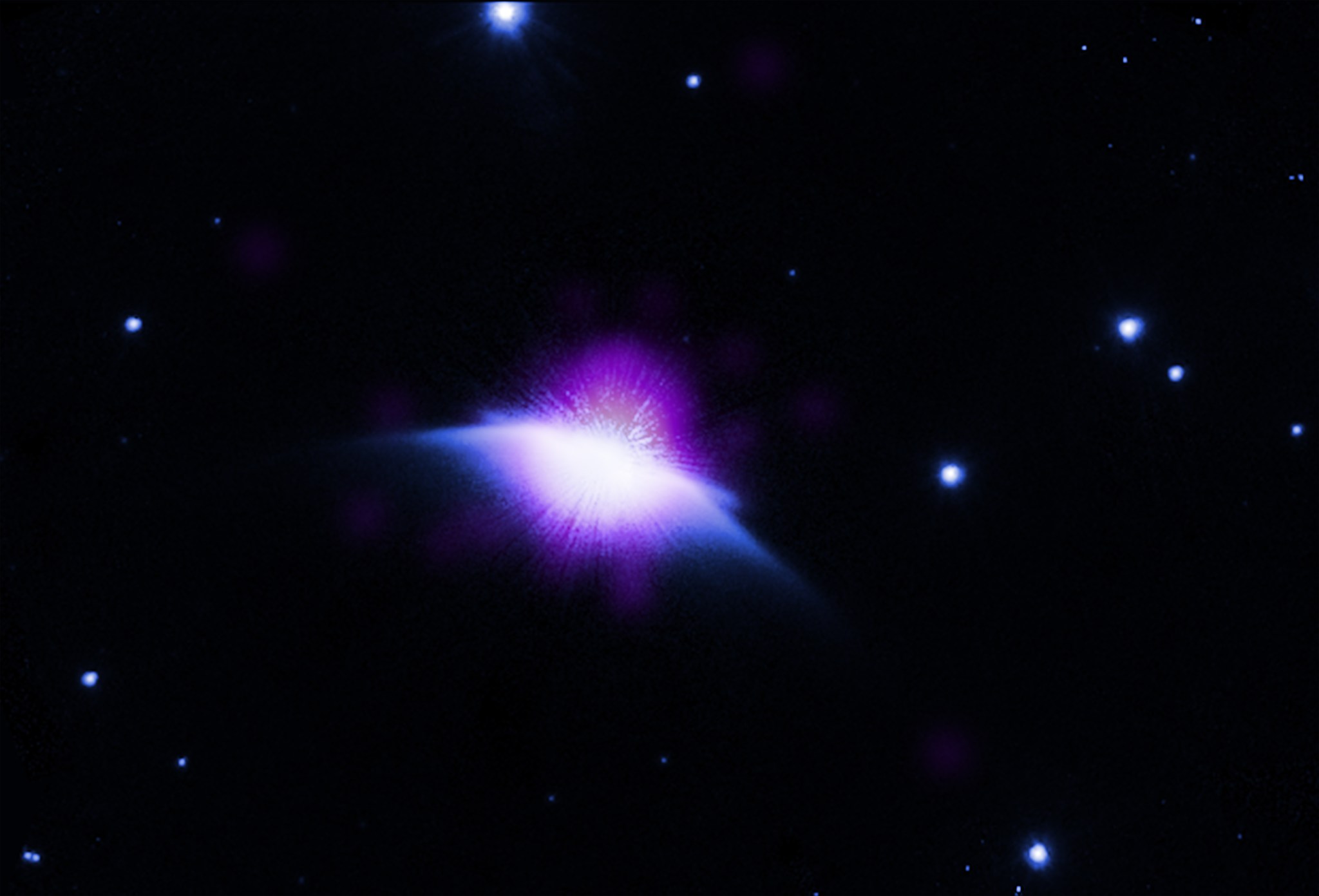
HD 61005 in X-ray and Infrared light.X-ray: NASA/CXC/John Hopkins Univ./C.M. Lisse et al.; Infrared: NASA/ESA/STIS; Image Processing: NASA/CXC/SAO/N. Wolk
<関連情報>
- https://www.nasa.gov/missions/chandra/young-sun-caught-blowing-bubbles-by-nasas-chandra/
- https://iopscience.iop.org/article/10.3847/1538-4357/ae2eda
チャンドラ衛星による主系列G星の天体圏の初解像 First Resolution of a Main-sequence G star’s Astrosphere Using Chandra
C. M. Lisse, S. J. Wolk, B. Snios, R. L. McNutt Jr., J. D. Slavin, R. A. Osten, D. C. Hines, J. H. Debes, D. Koutroumpa, V. Kharchenko,…
The Astrophysical Journal Published: 2026 March 3
DOI:10.3847/1538-4357/ae2eda
Abstract
We report the resolution of a halo of X-ray line emission surrounding the zero-age main-sequence G8.5V star HD 61005 by Chandra/ACIS-S. Located only ∼36 pc distant, HD 61005 is young (100 ± 50 Myr) and X-ray bright (∼300 × solar), observed with a nearly edge-on geometry and surrounded by very local interstellar medium (VLISM) material denser than in the Sun’s environs. HD 61005 is known to harbor large amounts of circumstellar dust in a dense ecliptic plane full of millimeter-sized particles plus attached, extended “Wing like structures” full of micron-sized particles, which are evidence for strong VLISM–dust disk interaction. These properties aided our ability to resolve the system’s ∼220 au wide astrosphere, the first ever observed for a main-sequence G star. The observed X-ray emission morphology is roughly spherical, as expected for an astrospheric structure dominated by the host star. The Chandra spectrum of HD 61005 is a combination of a hard stellar coronal emission (T ∼ 8 MK) at LX ∼ 6 × 1029 erg s−1, plus an extended halo contribution at LX ∼ 1 × 1029 erg s−1 dominated by charge exchange (CX) lines, such as those of O VIII and Ne IX. The Chandra CX X-ray morphology does not track the planar dust morphology but does extend out roughly to ∼110 au where the base of the dust wings begins. We present a toy model of the astrosphere emission produced by stellar wind–VLISM CX interactions, similar to the state of the young Sun when it was only ∼108 yr old and transiting through an ∼103 times denser part of the interstellar medium (such as a giant molecular cloud).