2026-02-20 大阪公立大学
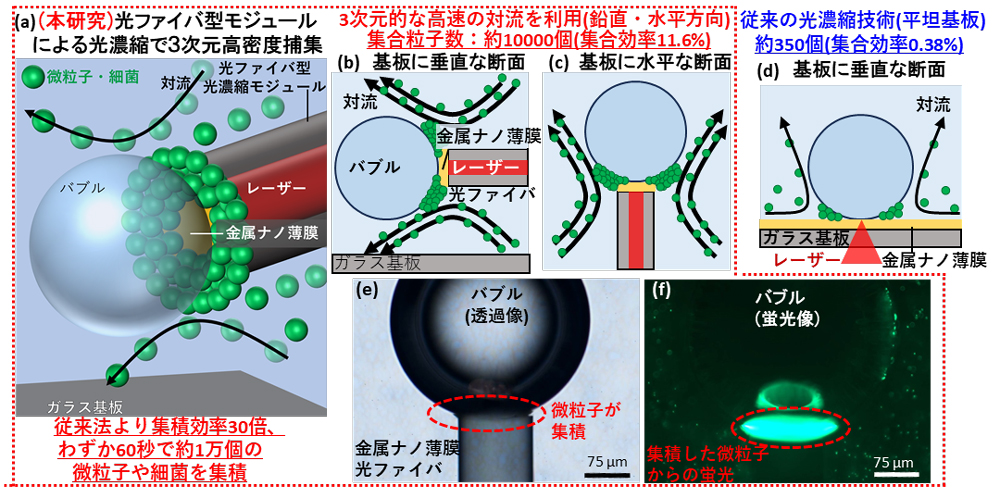
図1 (a)本研究で開発した光ファイバ型モジュールによる光濃縮の3次元模式図、(b)基板に垂直な断面、(c)水平な断面での模式図。(d)従来の平坦基板を用いた光濃縮法の模式図。光ファイバ型光濃縮を行った後の(e)光学透過像、および(f)蛍光像(ナノ・マイクロ蛍光ポリスチレン粒子を使用)。
<関連情報>
- https://www.omu.ac.jp/info/research_news/entry-22465.html
- https://www.nature.com/articles/s42005-025-02480-9
金コーティング光ファイバーモジュールを用いたナノ粒子および微粒子の高効率3次元光凝縮 Highly efficient three-dimensional optical condensation of nano- and micro-particles using a gold-coated optical fibre module
Kota Hayashi,Mamoru Tamura,Masazumi Fujiwara,Shiho Tokonami & Takuya Iida
Communications Physics Published:19 February 2026
DOI:https://doi.org/10.1038/s42005-025-02480-9
Abstract
Detecting trace amounts of harmful bacteria and nanoscale biomarkers is essential for early diagnosis and disease prevention. However, conventional methods, such as cultivation and immunoassays, are time-consuming and suffer from limited biological sensitivity. To address these limitations, we developed a rapid and highly sensitive detection method based on optical condensation using a metallic thin-film-coated optical fibre module. Acting as a photothermal source, this module induces convection and bubble formation at the fibre tip, enabling efficient three-dimensional condensation of targets within liquid samples. When positioned away from the substrate, the module assembled 103–105 bacteria and microparticles from a 20 μL sample within 60 s. This approach increased assembly efficiency by more than ten-fold compared with conventional two-dimensional photothermal methods, concentrating over 10% of all target objects through combined horizontal and vertical convection. These findings highlight the potential of this technique for advancing bioanalytical detection, drug delivery and material assembly technologies.