
2026-02-09 カリフォルニア大学サンディエゴ校(UCSD)
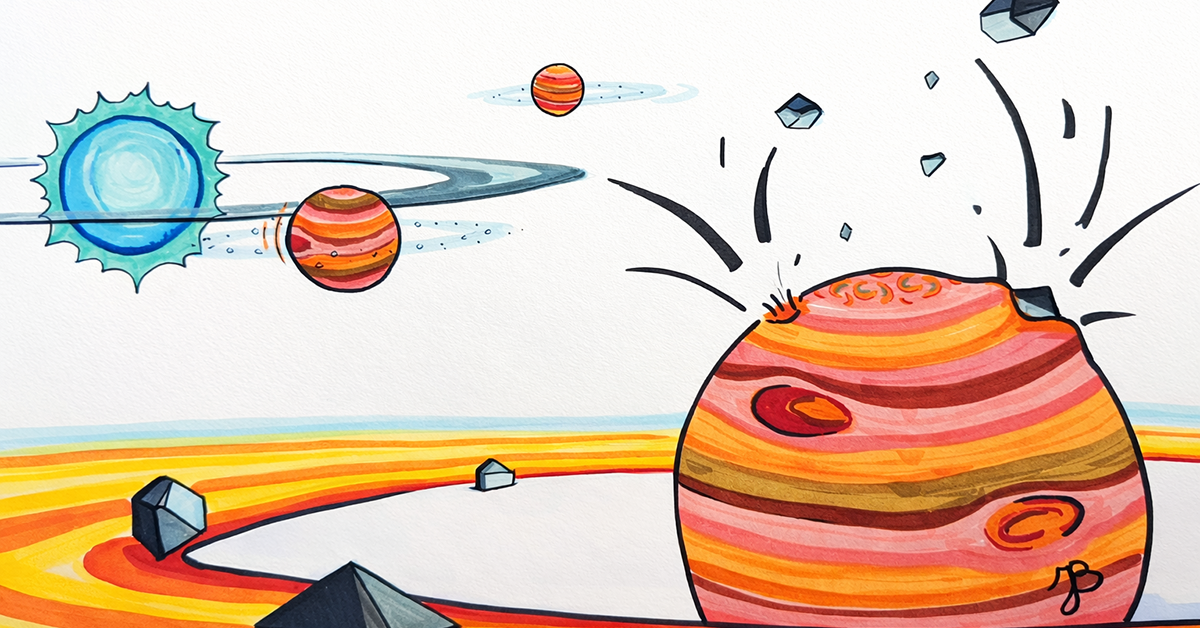
One way gas giants form is through core accretion, where solid cores gradually grow in a disk by pulling in rocky and icy pebbles until they become massive enough to attract the gas that surrounds young stars. (cr: Jean-Baptiste Ruffio)
<関連情報>
- https://today.ucsd.edu/story/how-big-can-a-planet-be
- https://www.nature.com/articles/s41550-026-02783-z
複数の巨大な太陽系外惑星からなる系における木星のような均一な金属濃縮 Jupiter-like uniform metal enrichment in a system of multiple giant exoplanets
Jean-Baptiste Ruffio,Jerry W. Xuan,Yayaati Chachan,Aurora Kesseli,Eve J. Lee,Charles Beichman,Klaus Hodapp,William O. Balmer,Quinn Konopacky,Marshall D. Perrin,Dimitri Mawet,Heather A. Knutson,Geoffrey Bryden,Thomas P. Greene,Doug Johnstone,Jarron Leisenring,Michael Meyer & Marie Ygouf
Nature Astronomy Published:09 February 2026
DOI:https://doi.org/10.1038/s41550-026-02783-z
Abstract
The accretion of icy and rocky solids during the formation of a gas-giant planet is poorly constrained and challenging to model. Refractory species, like sulfur, are present only in solids in the protoplanetary disk where planets form. Measuring their abundance in planetary atmospheres is one of the most direct ways of constraining the extent and mechanism of solid accretion. Here, using the unprecedented sensitivity of NASA’s James Webb Space Telescope, we measure in detail the chemical make-up of three massive gas giants orbiting the star HR 8799, including direct detections of H2O, CO, CH4, CO2, H2S, 13CO and C18O. We find that these planets are uniformly and highly enriched in heavy elements compared with the star, irrespective of their volatile (carbon and oxygen) or refractory (sulfur) nature, which strongly indicates that the accretion of solids was efficient during their formation. This composition closely resembles that of Jupiter and Saturn and demonstrates that this enrichment also occurs in systems with several gas-giant planets orbiting stars beyond the Solar System. This discovery hints at a shared origin for the heavy-element enrichment of giant planets across a wider range of planet masses and orbital separations than previously anticipated.


