2026-01-27 NASA
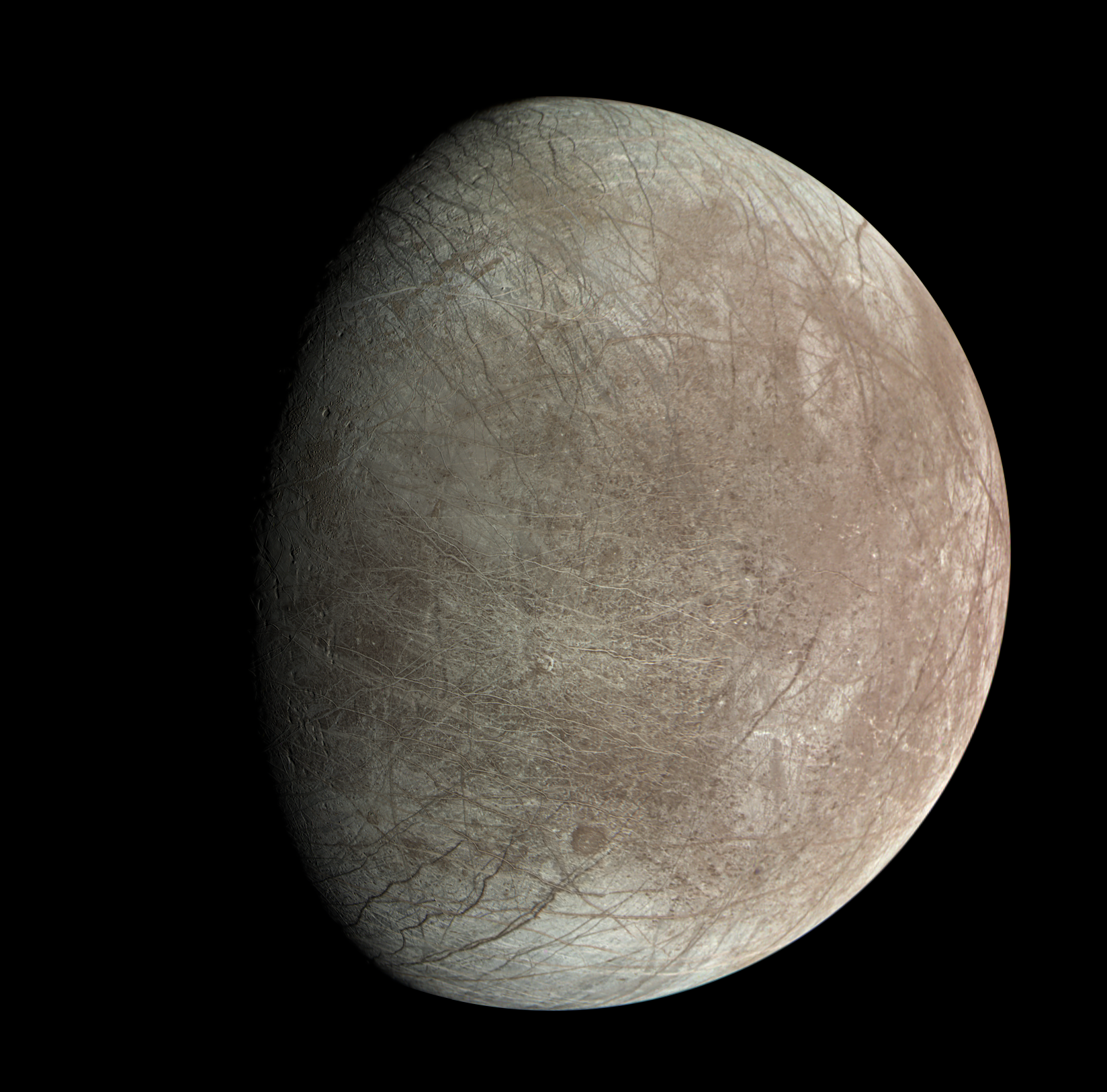
Jupiter’s moon Europa was captured by the JunoCam instrument aboard NASA’s Juno spacecraft during the mission’s close flyby on Sept. 29, 2022. The images show the fractures, ridges, and bands that crisscross the moon’s surface.Image data: NASA/JPL-Caltech/SwRI/MSSS Image processing: Björn Jónsson (CC BY 3.0)
<関連情報>
- https://www.nasa.gov/missions/juno/nasas-juno-measures-thickness-of-europas-ice-shell/
- https://www.nature.com/articles/s41550-025-02718-0
ジュノーマイクロ波放射計によって特徴付けられたエウロパの氷の厚さと地下構造 Europa’s ice thickness and subsurface structure characterized by the Juno microwave radiometer
S. M. Levin,Z. Zhang,S. J. Bolton,S. Brown,A. I. Ermakov,J. Feng,K. Hand,S. Misra,M. Siegler,D. Stevenson,W. McKinnon & R. Akiba
Nature Astronomy Published:17 December 2025
DOI:https://doi.org/10.1038/s41550-025-02718-0
Abstract
Jupiter’s moon Europa is thought to harbour a saltwater ocean beneath a variously disrupted ice shell, and it is, thus, one of the highest priority astrobiology targets in the Solar System. Estimates of the ice-shell thickness range from 3 km to over 30 km, and observations by the Galileo spacecraft indicated widespread regions of ice disruption (chaotic terrain) leading to speculation that the ice shell may contain subsurface cracks, faults, pores or bubbles. If persistent, subsurface cracks could provide pathways for habitability by facilitating the transport of oxygen and nutrients between the surface and the ocean. Here we report on observations of Europa’s subsurface ice shell obtained by the Juno microwave radiometer in 2022. For the idealized case of pure water ice, the data are consistent with the existence of a thermally conductive ice shell with a thickness of 29 ± 10 km and with the presence of cracks, pores or other scatterers extending to depths of hundreds of metres below the surface with a characteristic size smaller than a few centimetres in radius. An ice-shell salinity of 15 mg kg−1, as indicated by models based on terrestrial marine ice, would reduce our estimate of the thickness of the ice shell by about 5 km, substantially less than our 10 km uncertainty. The low volume fraction, small size and shallow depth of the scatterers indicate that the fracture interfaces observed at Europa’s surface are alone unlikely to be capable of carrying nutrients between the surface and the ocean.