2026-01-22 ゲーテ大学
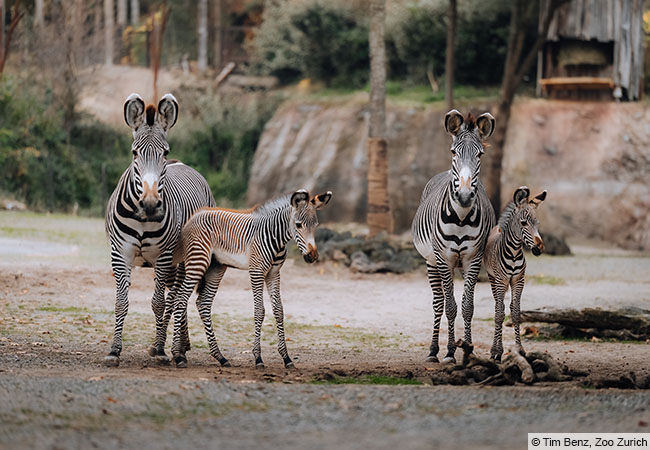
The analysis of Meireles and colleagues shows that reproduction, as shown here in the endangered Grévy’s zebra (Equus grevyi), is on the decrease across zoo mammal populations. © Tim Benz, Zoo Zurich
<関連情報>
- https://aktuelles.uni-frankfurt.de/english/aging-zoo-animals-threaten-long-term-species-conservation-goals-of-modern-zoos/
- https://www.pnas.org/doi/abs/10.1073/pnas.2522274123
- https://www.sciencedirect.com/science/article/pii/S2215016125004352
高齢化が動物園の保全目標を脅かす Aging populations threaten conservation goals of zoos
João Pedro Meireles, Max Hahn-Klimroth, Laurie Bingaman Lackey, +5 , and Marcus Clauss
Proceedings of the National Academy of Sciences Published:January 20, 2026
DOI:https://doi.org/10.1073/pnas.2522274123
Significance
Zoos play an important role for global biodiversity through education, ex situ conservation, and reintroduction programs. For wildlife species currently threatened in their natural habitats or predicted to decline under future global change, it is essential that self-supporting ex situ populations are managed sustainably. However, due to limited space for placing new offspring, current management practices often curtail animal reproduction. Here, we show that by following this approach, zoo mammal populations in North America and Europe have, on average, become older and less reproductively active, with no end to these trajectories in sight. This makes a number of current zoo populations vulnerable to aging demographics. For zoos to fulfill their conservation mandate, these trends must be stopped or possibly reversed.
Abstract
Improvements in wildlife husbandry mean that many zoo animals are living longer. This has put pressure on the finite holding capacity of zoos, which has often been addressed through a curtailing of reproduction to reduce population growth rates. Here, we explore how such actions have impacted the demographic trends of 774 mammal populations in European and North American zoo populations between 1970 and 2023. Irrespective of whether the data are clustered by region, taxonomic group, conservation status, or breeding program type, the proportion of old individuals has increased continuously, mirrored by a decrease in juveniles and actively reproducing adults. This aging demographic trend compromises the long-term sustainability of zoo populations and thus the ability of zoos to meet ex situ conservation goals. As the observed trends do not show signs of abating, reflection on current zoo population management is required.
人口ピラミッドに基づく人口動態研究のための半自動アプローチ A semi-automatic approach to study population dynamics based on population pyramids
Max Hahn-Klimroth, João Pedro Meireles, Laurie Bingaman Lackey, Nick van Eeuwijk, Mads F. Bertelsen, Paul W. Dierkes, Marcus Clauss
MethodsX Available online: 2 September 2025
DOI:https://doi.org/10.1016/j.mex.2025.103591
Abstract
The depiction of populations – of humans or animals – as ‘population pyramids’ is a useful tool for the assessment of various characteristics of populations at a glance. Although these visualisations are well-known objects in various communities, formalised and algorithmic approaches to gain information from these data are less present. Here, we present an algorithm-based classification of population data into ‘pyramids’ of different shapes that can be linked to typical demographic properties. The classification accuracy of the algorithm was tested on over 50,000 population pyramids from 450 mammal species. The approach delivers plausible classifications, in particular with respect to changes in population size linked to specific series of, and transitions between, different ‘pyramid’ shapes. We believe this approach might become a useful tool for analysing and communicating historical population developments in multiple contexts and is of broad interest. Moreover, it might be useful for animal population management strategies.
- Introducing a deterministic algorithmic approach to classify population pyramid data.
- Data discretization step to reduce data complexity and to unify data.
- Classification of a population pyramid into non-species-specific shape categories that are linked to specific characteristics of the population.