2026-01-19 分子科学研究所
<関連情報>
回折限界を突破する探針増強和周波振動ナノ分光 Tip-Enhanced Sum-Frequency Vibrational Nanoscopy beyond the Diffraction Limit
Shota Takahashi,Koichi Kumagai,Atsunori Sakurai,Tatsuto Mochizuki,Tomonori Hirano,Akihiro Morita,and Toshiki Sugimoto
The Journal of Physical Chemistry C Published: December 11, 2025
DOI:https://doi.org/10.1021/acs.jpcc.5c05411
Abstract
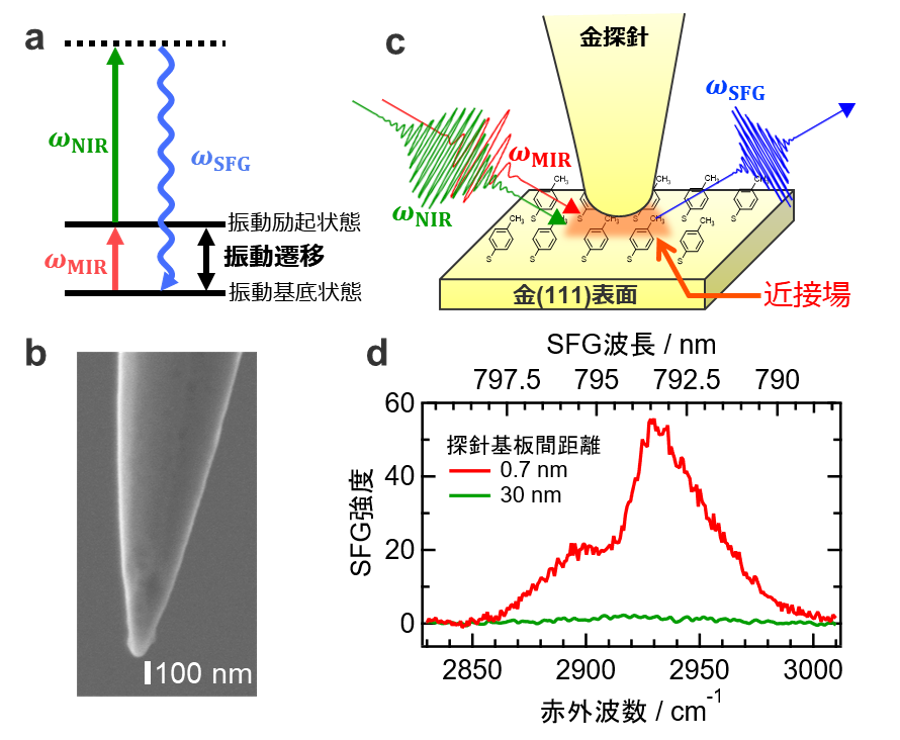
Sum-frequency generation (SFG) is a powerful second-order nonlinear spectroscopic technique that provides detailed insights into molecular structures and absolute orientations at surfaces and interfaces. However, conventional SFG based on far-field schemes suffers from the diffraction limit of light, which inherently averages spectroscopic information over micrometer-scale regions and obscures nanoscale structural inhomogeneity. Here, we overcome this fundamental limitation by leveraging a highly confined optical near field within a tip–substrate nanogap of a scanning tunneling microscope (STM), pushing the spatial resolution of SFG down to ∼10 nm, a nearly two-orders-of-magnitude improvement over conventional far-field SFG. By capturing tip-enhanced SFG (TE-SFG) spectra concurrently with STM scanning, we demonstrate the capability to resolve nanoscale variation in molecular adsorption structures across distinct interfacial domains. To rigorously interpret the observed TE-SFG spectra, we newly developed a comprehensive theoretical framework for the TE-SFG process and confirm via numerical simulations that the TE-SFG response under our current experimental conditions is dominantly governed by the dipole-field interactions, with negligible contributions from higher-order multipole effects. The dominance of the dipole mechanism ensures that the observed TE-SFG spectra faithfully reflect not only nanoscale interfacial structural features but also absolute up/down molecular orientations. This study presents the first experimental realization of second-order nonlinear vibrational SFG nanoscopy beyond the diffraction limit, opening a new avenue for nanoscale domain-specific investigation of molecular structures and dynamics within inhomogeneous interfacial molecular systems beyond the conventional far-field SFG and STM imaging.