2026-01-08 自然科学研究機構
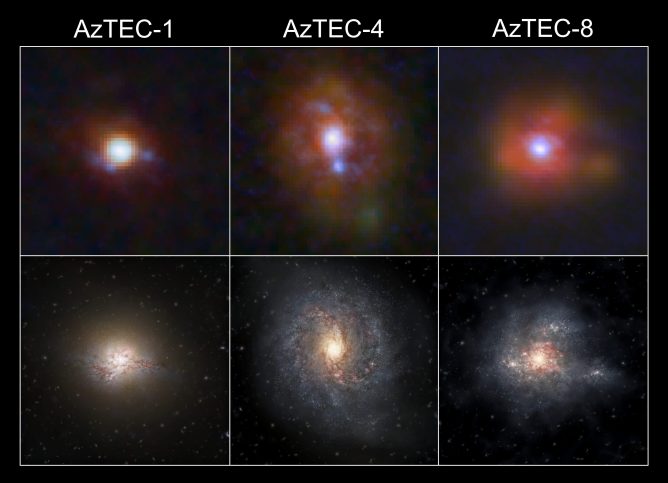
図1:(上段)アルマ望遠鏡とジェームズ・ウェッブ宇宙望遠鏡(JWST)による観測画像。アルマ望遠鏡で捉えた星形成領域を青で、JWSTが捉えた恒星の分布を赤で示している。(下段)それぞれのモンスター銀河のイメージ図。(クレジット:国立天文台)
<関連情報>
- https://alma-telescope.jp/news/press/multipleorigins-202601.html
- https://iopscience.iop.org/article/10.3847/1538-4357/ae157e
高輝度サブミリ波銀河における下部構造の形成(FOSSILS):高輝度サブミリ波銀河におけるスターバーストを引き起こす複数の経路の証拠 Formation of Substructure in Luminous Submillimeter Galaxies (FOSSILS): Evidence of Multiple Pathways to Trigger Starbursts in Luminous Submillimeter Galaxies
Ryota Ikeda, Daisuke Iono, Ken-ichi Tadaki, Maximilien Franco, Min S. Yun, Jorge A. Zavala, Yoichi Tamura, Takafumi Tsukui, Christina C. Williams, Bunyo Hatsukade,…
The Astrophysical Journal Published: 2026 January 8
DOI:10.3847/1538-4357/ae157e
Abstract
We present an analysis of rest-frame optical and far-infrared continuum emission in three luminous submillimeter galaxies (SMGs) at 3.0 ≲ z ≲ 4.5. The SMGs are spatially resolved down to 400–500 pc () resolution by James Webb Space Telescope and Atacama Large Millimeter/submillimeter Array observations. Despite similarities in their observed far-infrared properties (flux density, infrared luminosity, and effective radius), the three SMGs exhibit heterogeneous morphologies both across wavelengths and among the sources themselves. While two of them (AzTEC-4 and AzTEC-8) show a disk-like structure in the optical continuum, AzTEC-1 is dominated by a highly concentrated component with a Sérsic index of n = 5.4, where its far-infrared continuum emission is clumpy and less concentrated. AzTEC-4, which is confirmed to be at z = 4.198, shows a two-arm spiral of dust, but not in the stellar distribution. These three SMGs exemplify that multiple physical mechanisms exist in triggering starbursts in luminous SMGs at high redshift: secular instability in gas disks (AzTEC-4) in addition to possible minor mergers (AzTEC-8), and a combination of the efficient gas supply to the central core induced by a gas-rich major merger and the re-formation of a cold gas disk (AzTEC-1).