2025-12-24 カナダ・ブリティッシュコロンビア大学(UBC)
<関連情報>
- https://news.ubc.ca/2025/12/how-changing-your-diet-could-help-save-the-world/
- https://iopscience.iop.org/article/10.1088/2976-601X/ae10c0
27億人の食事由来の温室効果ガス排出量は、すでに2℃の気候目標を達成するために必要な個人の二酸化炭素排出量を超えている Dietary GHG emissions from 2.7 billion people already exceed the personal carbon footprint needed to achieve the 2 °C climate goal
Juan Diego Martinez and Navin Ramankutty
Environmental Research: Food Systems Published: 11 November 2025
DOI:10.1088/2976-601X/ae10c0
Abstract
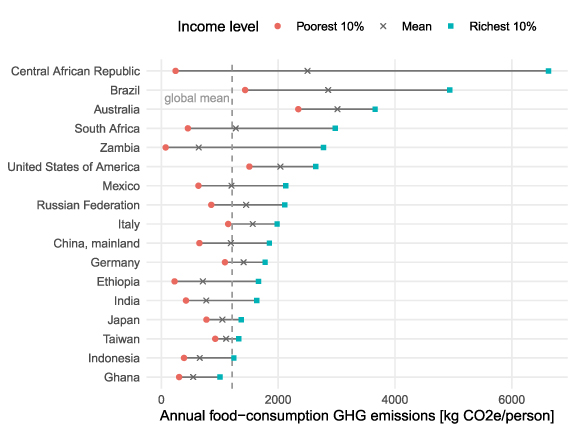
Our current global food system is failing to feed the world while simultaneously emitting between 26%–34% of greenhouse gases (GHGs) that alone could preclude us from meeting the Paris climate agreement goal of limiting warming to 1.5 °C or 2 °C above pre-industrial levels. But emissions from food consumption are not uniform amongst the world’s inhabitants and thus, we estimate those differentiated responsibilities. As expected, the emissions from those barely eating enough to survive are among the lowest. But the interplay of production practices, trade, dietary preferences, the nutrition transition, and within-country inequality in access to food shape the variations in global food system emissions. By combining the most recent estimates of access to food by income decile with trade-adjusted GHG emissions data for food, we present estimates of the inequality in emissions from food consumption on a global scale. We find that the top 15% of emitters account for 30% of the total emissions, equalling the contribution of the bottom 50%. Furthermore, we assess the reductions required from the top emitters to achieve two goals. First, to yield space for increased emissions to those not meeting basic dietary requirements to thrive; we find that only an additional 0.4% of the population in 2012 would need to cap their emissions so that 8.8% of the population can increase their emissions and be able to thrive. Second, to reduce agricultural GHG emissions to meet the 2 °C goal, we find that, between 40%–45% of the world’s population in 2012 consumed diets above a target per capita cap, while 89%–91% consumed diets above a target per capita cap calculated using a future 2050 population. This means that efforts to reduce emissions from the food system will be part of almost everyone’s life up to 2050 but for at least 40% that responsibility starts now.