2025-12-22 チャルマース工科大学
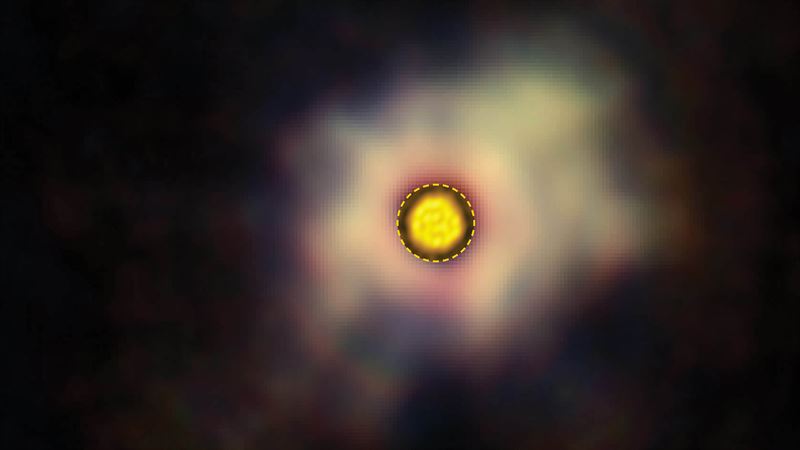
Starlight and stardust are not enough to drive the powerful winds of giant stars, transporting the building blocks of life through our galaxy. That’s the conclusion of a new study from Chalmers University of Technology, Sweden, of red giant star R Doradus. The result overturns a long-held idea about how the atoms needed for life are spread.
<関連情報>
- https://news.cision.com/chalmers/r/stardust-study-resets-how-life-s-atoms-spread-through-space,c4285089
- https://www.aanda.org/articles/aa/full_html/2025/12/aa56884-25/aa56884-25.html
漸近巨星分枝星Rドラダスの拡張大気と内層の経験的観察 II. 放射伝達モデルによるダスト特性の制約 An empirical view of the extended atmosphere and inner envelope of the asymptotic giant branch star R Doradus II. Constraining the dust properties with radiative transfer modelling
Thiebaut Schirmer, Theo Khouri, Wouter Vlemmings, Gunnar Nyman, Matthias Maercker, Ramlal Unnikrishnan, Behzad Bojnordi Arbab, Kirsten K. Knudsen and Susanne Aalto
Astronomy & Astrophysics Published:27 November 2025
DOI:https://doi.org/10.1051/0004-6361/202556884
Abstract
Context. Mass loss in oxygen-rich asymptotic giant branch (AGB) stars remains a longstanding puzzle, as the dust species detected around these stars appear too transparent to drive winds through the absorption of radiation alone. The current paradigm consists of outflows driven by photon scattering and requires relatively large grains (∼0.3 μm). Whether the necessary number of grains with the required scattering properties exist around AGB stars remains to be determined empirically.
Aims. We test whether the dust grains observed around the oxygen-rich AGB star R Doradus can drive its stellar wind by combining, for the first time, polarimetric constraints with elemental abundance limits and force balance calculations. We examine Fe-free silicates (MgSiO3), aluminium oxide (Al2O3), and Fe-bearing silicates (MgFeSiO4) to determine whether any dust species can generate sufficient radiative pressure under physically realistic conditions.
Methods. We analysed high-angular-resolution polarimetric observations obtained with SPHERE/ZIMPOL at the Very Large Telescope (VLT) and modelled the circumstellar dust using the radiative transfer code RADMC-3D. Dust optical properties were computed using Optool for both Mie and the distribution of hollow spheres (DHS) scattering theories. By systematically exploring a six-dimensional parameter space, we derived constraints on dust grain sizes, density profiles, and wavelength-dependent stellar radii. For models that successfully fit the observations, we analysed the results taking into consideration recent models for the gas density distribution around R Dor, and applied a multi-criteria zone analysis incorporating gas-depletion constraints and radiation pressure thresholds to assess dust-driven wind viability.
Results. We find sub-micron MgSiO3 and Al2O3 grains (up to 0.1 μm) regardless of scattering theory considered, and a two-layer dust envelope with steep density profiles (r−3.4 to r−4.1). Despite matching observed scattered-light patterns, these grains generate insufficient radiative force under physically realistic gas-to-dust mass ratios, even when assuming complete elemental depletion. Silicates containing Fe could theoretically provide adequate force, but would sublimate in critical acceleration regions and require implausibly high silicon-depletion levels.
Conclusions. Our findings for R Doradus show insufficient radiation pressure from scattering on grains, suggesting that dust alone cannot drive the wind in this star and that additional mechanisms may be required.