2025-12-19 東京科学大学
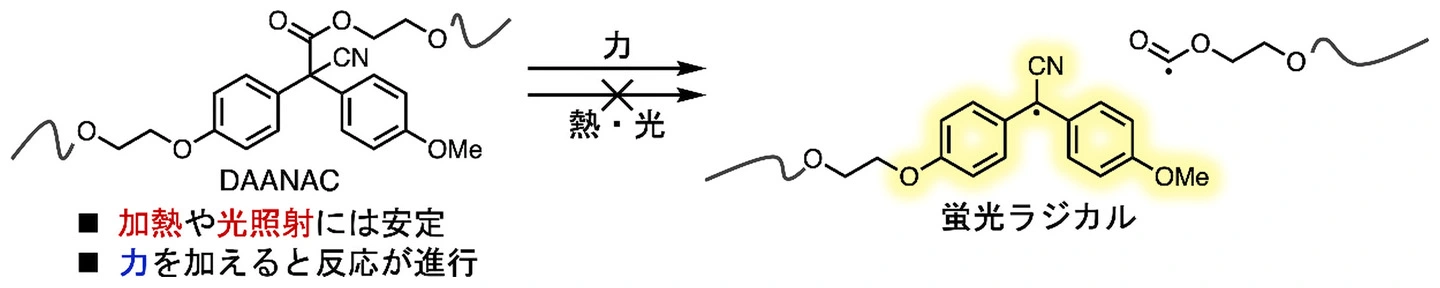
図1. 本研究の概要図
<関連情報>
- https://www.isct.ac.jp/ja/news/1zvwf9sky9cs
- https://www.isct.ac.jp/plugins/cms/component_download_file.php?type=2&pageId=&contentsId=1&contentsDataId=2895&prevId=&key=cc9340ff3c203c425c97c13b4421aae4.pdf
- https://pubs.acs.org/doi/10.1021/jacs.5c15553
耐久性のある機械応答性ポリマーのための熱的および光化学的に安定な蛍光ラジカル型メカノフォア A Thermally and Photochemically Stable Fluorescent Radical-type Mechanophore for Durable Mechanoresponsive Polymers
Yuto Uchida,Hajime Sugita,Akira Takahashi,Hideyuki Otsuka
Journal of the American Chemical Society Published: November 23, 2025
DOI:https://doi.org/10.1021/jacs.5c15553
Abstract
The development of mechanophores has opened new avenues in the design of functional materials; however, most reported mechanophores rely on thermally or photochemically labile bonds, which limits their stability under practical conditions. Herein, we report diarylacetonitrile-α-carboxylic ester (DAANAC) as a robust radical-type mechanophore (RM) that is inert to both thermal and photochemical stimuli. DAANAC exhibits remarkable stability upon heating above 200 °C and demonstrates excellent photostability under UV irradiation at 365 and 254 nm. In contrast, DAANAC generates fluorescent diarylacetonitrile radicals upon mechanical activation, such as grinding or stretching, when incorporated into linear or cross-linked polymers. Tensile tests of DAANAC-cross-linked elastomers show strain-induced fluorescence and stress–strain behavior comparable to that of the control elastomer without mechanophores, underscoring its ability to visualize mechanical damage without compromising mechanical properties. These findings establish DAANAC as a unique fluorescent RM that bridges the gap between force responsiveness and structural robustness, expanding the design space for durable mechanoresponsive polymers.