
2025-12-10 京都大学
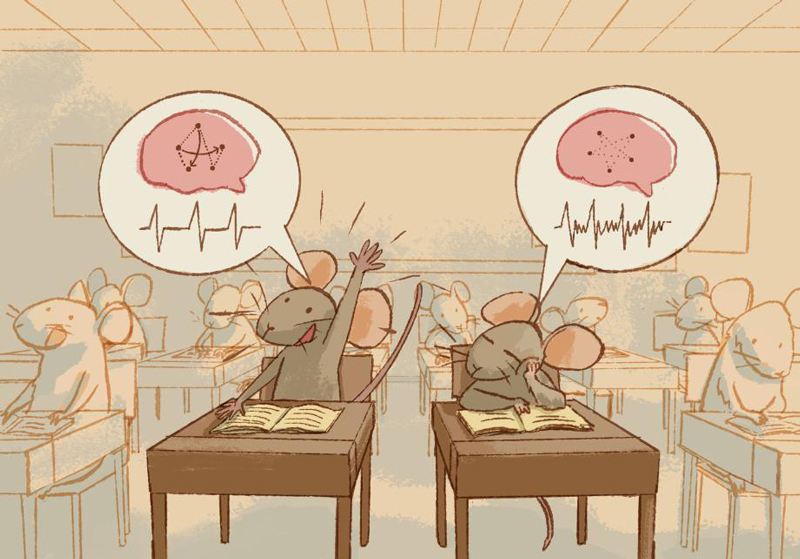
成績が良いマウスと悪いマウスの脳活動の違いを表すイメージ図(Illust. Robin Hoshino)
<関連情報>
- https://www.kyoto-u.ac.jp/ja/research-news/2025-12-10
- https://www.kyoto-u.ac.jp/sites/default/files/2025-12/web_2512_Shimazaki_NatCommun251209-96b6d9d044dea8667eb5b85eeca758b5.pdf
- https://www.nature.com/articles/s41467-025-66669-w
状態空間運動論的イジングモデルは、まばらに活動する非平衡神経ダイナミクスにおけるタスク依存のエントロピーフローを明らかにする State-space kinetic Ising model reveals task-dependent entropy flow in sparsely active nonequilibrium neuronal dynamics
Ken Ishihara & Hideaki Shimazaki
Nature Communications Published:09 December 2025
DOI:https://doi.org/10.1038/s41467-025-66669-w
Abstract
Neuronal ensemble activity, including coordinated and oscillatory patterns, exhibits hallmarks of nonequilibrium systems with time-asymmetric trajectories to maintain their organization. However, assessing time asymmetry from neuronal spiking activity remains challenging. The kinetic Ising model provides a framework for studying the causal, nonequilibrium dynamics in spiking recurrent neural networks. Recent theoretical advances in this model have enabled time-asymmetry estimation from large-scale steady-state data. Yet, neuronal activity often exhibits time-varying firing rates and coupling strengths, violating the steady-state assumption. To overcome this limitation, we developed a state-space kinetic Ising model that accounts for nonstationary and nonequilibrium properties of neural systems. This approach incorporates a mean-field method for estimating time-varying entropy flow, a key measure for maintaining the system’s organization through dissipation. Applying this method to mouse visual cortex data revealed greater variability in causal couplings during task engagement despite reduced neuronal activity with increased sparsity. Moreover, higher-performing mice exhibited increased coupling-related entropy flow per spike during task engagement, suggesting more efficient computation in the higher-performing mice. These findings underscore the model’s utility in uncovering intricate asymmetric causal dynamics in neuronal ensembles and linking them to behavior through the thermodynamic underpinnings of neural computation.



