2025-12-10 カリフォルニア大学バークレー校 (UCB)
<関連情報>
- https://news.berkeley.edu/2025/12/10/a-new-hypertropical-climate-is-emerging-in-the-amazon/
- https://www.nature.com/articles/s41586-025-09728-y
アマゾンの暑い干ばつは将来の熱帯気候を予兆する Hot droughts in the Amazon provide a window to a future hypertropical climate
Jeffrey Q. Chambers,Adriano José Nogueira Lima,Gilberto Pastorello,Bruno Oliva Gimenez,Lin Meng,Lee A. Dyer,Yanlei Feng,Cristina Santos da Silva,Regison Costa de Oliveira,Anna Weber,Charlie Koven,Robinson Negrón-Juárez,Gustavo C. Spanner,Tatiana D. Gaui,Clarissa G. Fontes,Alessandro C. de Araújo,Nate McDowell,Ruby Leung,Daniel Magnabosco Marra,Jeffrey Warren,Daisy Celestina Souza,Cynthia Wright,Kolby Jardine,Marcos Longo,… Niro Higuchi
Nature Published:10 December 2025
DOI:https://doi.org/10.1038/s41586-025-09728-y
Abstract
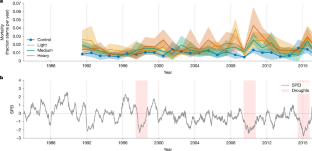
Tropical forests represent the warmest and wettest of Earth’s biomes, but with continued anthropogenic warming, they will be pushed to climate states with no current analogue1,2. Droughts in the tropics are already becoming more intense as they occur at successively higher temperatures3,4,5. Here we synthesize multiple datasets to assess the effects of hot droughts on a central Amazon forest. First, a more than 30-year record of annually resolved forest demographic data from a selective logging experiment showed higher tree mortality during intense droughts, particularly among fast-growing pioneer species with low wood density. Second, analysis of ecophysiological field measurements from the 2015 and 2023 El Niño droughts identified a soil moisture threshold beyond which transpiration rates rapidly declined. As rainless days beyond this threshold continued, drought conditions intensified, increasing the potential for tree mortality from hydraulic failure and carbon starvation. Third, analyses from the Coupled Model Intercomparison Project Phase 6 demonstrated that under high-emission scenarios, a large area of tropical forest will shift to a hotter ‘hypertropical’ climate by 2100. Last, under a hypertropical climate, temperature and moisture conditions during typical dry season months will more frequently exceed identified drought mortality thresholds, elevating the risk of forest dieback. Present-day hot droughts are harbingers of this emerging climate, offering a window for studying tropical forests under expected extreme future conditions6,7,8.