2025-12-08 韓国基礎科学研究院(IBS)
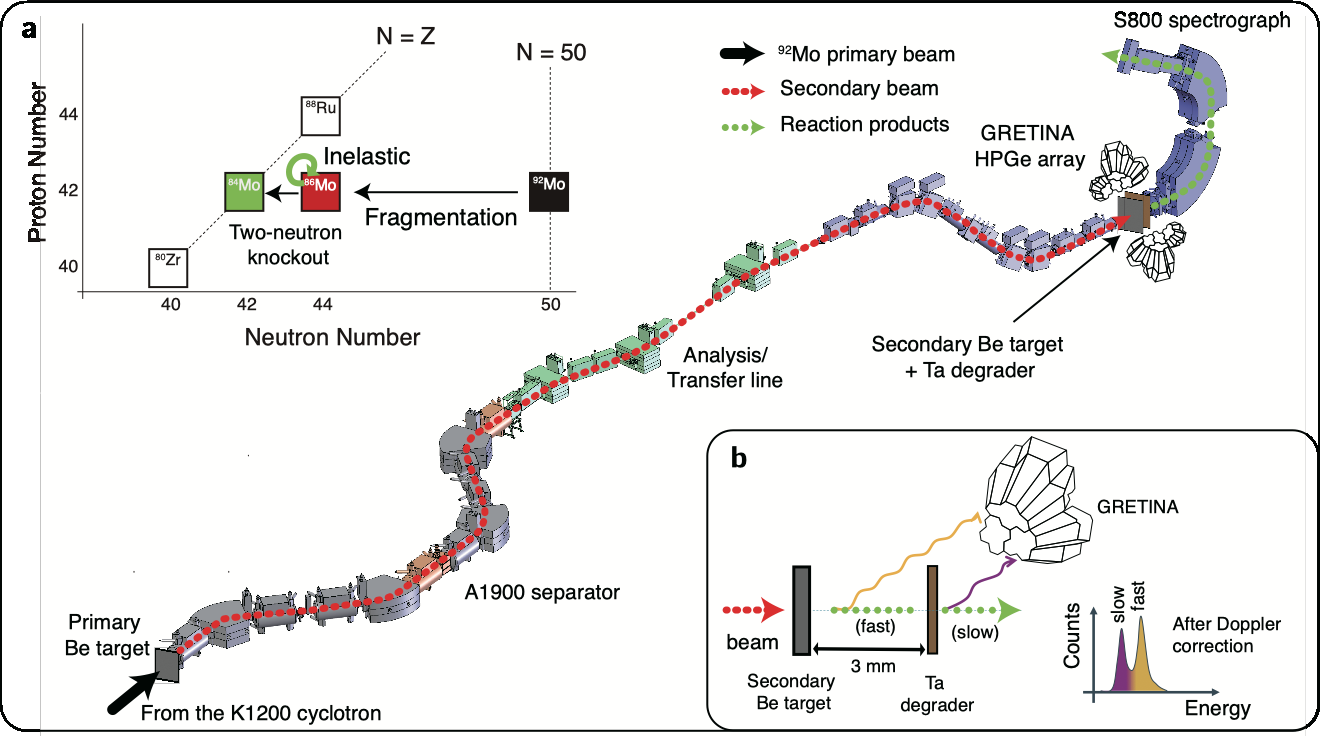 Figure 1. Schematic figure of the experimental setup. (a) A Mo-92 beam impinges on a primary beryllium target, producing several nuclides, including Mo-86. The secondary beam then collides with a secondary beryllium target, generating excited states of Mo-86 and Mo-84. (b) The excited nuclei transition to the ground state, emitting gamma rays, which are detected by the high-purity germanium detector array GRETINA. A tantalum foil is placed behind the secondary target to reduce the velocity of in-flight ions, so that some of the gamma rays are emitted before passing through the foil, while the others are emitted afterwards. The gamma-ray spectrum requires Doppler correction because the beam is so fast, approximately 30% of the speed of light. After Doppler correction for one of the two speeds (fast/slow), the gamma-ray spectrum appears as two peaks, as shown in the figure. (Ha et al., Nature Communications)
<関連情報>
- https://www.ibs.re.kr/cop/bbs/BBSMSTR_000000000738/selectBoardArticle.do?nttId=26434&pageIndex=1&searchCnd=&searchWrd=#toggle
- https://www.nature.com/articles/s41467-025-65621-2
モリブデンの異種同位体の急激な構造変化により、アイソスピン対称性の反転島が明らかになる Abrupt structural transition in exotic molybdenum isotopes unveils an isospin-symmetric island of inversion
J. Ha,F. Recchia,S. M. Lenzi,H. Iwasaki,D. D. Dao,F. Nowacki,A. Revel,P. Aguilera,G. de Angelis,J. Ash,D. Bazin,M. A. Bentley,S. Biswas,S. Carollo,M. L. Cortes,R. Elder,R. Escudeiro,P. Farris,A. Gade,T. Ginter,M. Grinder,J. Li,D. R. Napoli,S. Noji,… D. Weisshaar
Nature Communications Published:27 November 2025
DOI:https://doi.org/10.1038/s41467-025-65621-2
Abstract
Like electrons in atoms, protons and neutrons in nuclei occupy orbitals in a shell structure with energy gaps at magic numbers. Radioactive-beam experiments revealed the disappearance of magic numbers in some neutron-rich isotopes. In these nuclei, configurations involving particles excited across the shell gap gain correlation energy, becoming the ground state. Neutron-rich regions of the nuclear chart that exhibit this property are known as “Islands of Inversion”. Here we present the lifetime measurement of the first 2+ states in 84Mo (N = Z) and 86Mo (N = Z + 2) revealing an unexpected sharp structural change between them defining the edge of the region of deformation around 80Zr. Similarly to the neutron-rich N = 40 Island of Inversion near 64Cr where cross-shell excitations dominate, we identify this region as an Island of Inversion with symmetrical proton and neutron excitations that we term “Isospin-Symmetric Island of Inversion”. Three-nucleon forces are suggested to drive Mo isotope structural changes.