2025-12-08 シンガポール国立大学(NUS)
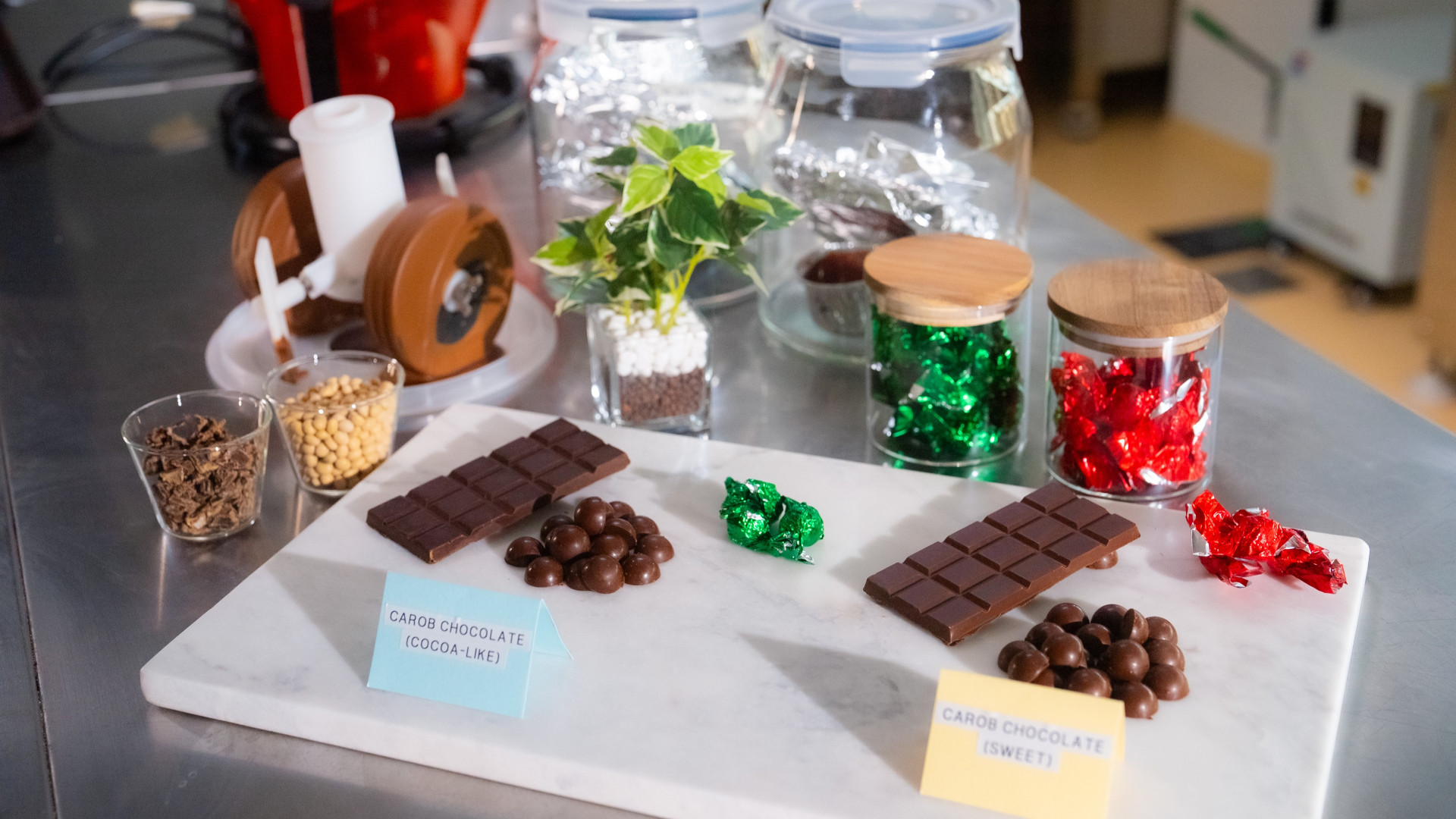 The NUS research team pioneered two innovative techniques using easy-to-obtain enzymes that alter the flavour of roasted carob pulp, enabling it to more closely mimic the rich bitterness and sweetness of cocoa. Credit: NUS Faculty of Science
<関連情報>
- https://news.nus.edu.sg/nus-scientists-enhance-flavour-of-carob-chocolate-alternatives/
- https://ift.onlinelibrary.wiley.com/doi/10.1111/1750-3841.70423
- https://www.sciencedirect.com/science/article/abs/pii/S0308814625024240
大豆タンパク質加水分解物は、イナゴマメベースのダークチョコレートのココアのような風味特性を強調します Soy Protein Hydrolysate Accentuates the Cocoa-Like Flavor Attributes of Carob-Based Dark Chocolate
Manfred Choo-Yong Ku, Faith Xinying Yeo, Xiangning Liu, Shao-Quan Liu
Journal of Food Science Published: 18 July 2025
DOI:https://doi.org/10.1111/1750-3841.70423
Abstract
ABSTRACT
Roasted carob pulp is known for its faint cocoa-like flavor. Although it exhibits potential as a cocoa replacer, its cocoa-like aroma and bitter taste are weaker than those of conventional cocoa. To shrink this flavor gap, the present study detailed a novel approach of tapping on crude protein hydrolysates for the accentuation of these flavor attributes in dark chocolates. A comparison between protease types (Flavourzyme and Neutrase) and protein substrates (whey, pea, soy, wheat, and endogenous carob pulp protein) revealed that soy protein hydrolysates derived from Flavourzyme treatment contained the highest branched-chain amino acids (BCAA; 68.82 mg/g) and short-chain peptide content (3.04 × 10⁷ peak area). Hydrolysate-added carob pulp was correlated with a distinct increase in BCAA-derived 2-methylbutanal (38.3%) and 3-methylbutanal (69.8%) and the generation of a diverse group of alkylpyrazines, including 2-methylpyrazine (0.34 µg/g) and 3-ethyl-2,5-dimethylpyrazine (0.12 µg/g). Descriptive sensory analysis revealed a distinct increase in bitterness, which could be correlated with the introduction of short-chain bitter peptides.
Practical Application
This study successfully validates an approach for the promotion of cocoa-like flavor attributes of roasted carob pulp. In light of current cocoa supply constraints and challenges in sustainable production, these findings are envisioned to enhance consumer acceptance of carob applications in cocoa-based products. This is especially significant for consumers who desire the cocoa-like flavor impression in such products.
アルカリ処理したショ糖を豊富に含むイナゴマメパルプの転化酵素前処理は焙煎中のO -複素環式化合物の生成を増加させる Invertase pre-treatment of alkalised sucrose-rich carob pulp augments O-heterocyclic compound generation during roasting
Manfred Choo-Yong Ku, Xiangning Liu, Shao-Quan Liu
Food Chemistry Available online: 16 June 2025
DOI:https://doi.org/10.1016/j.foodchem.2025.145173
Highlights
- Invertase pre-treatment successfully increased reducing sugar content in carob.
- Single-step alkalisation was associated with minimal changes in Maillard reaction.
- Upon invertase treatment, alkalisation led to a larger extent of Maillard reaction.
- Invertase pre-treatment enhanced the generation of O-heterocyclic compounds.
Abstract
Roasted carob pulp is a sucrose-rich ingredient with a distinct sweet taste and cocoa-like and caramel-like aroma attributes. Alkaline conditions promote a rapid onset of Maillard reaction but its impact on sucrose degradation remains unclear. Herein we report single-step alkalisation (pH 8) exerted no significant impact on sucrose degradation. Furthermore, single-step alkalisation exerted minimal flavour precursors changes (+17.73 mg/g reducing sugars, −3.50 mg/g amino acids) and intermediate generation (+25.40 μg/g α-dicarbonyls). Upon invertase treatment, alkalisation was associated with elevated utilisation of reducing sugars (−147.42 mg/g), amino acids (−4.49 mg/g) and increased generation of α-dicarbonyls (+36.03 μg/g). Invertase treatment of alkalised samples led to a larger generation of volatile oxygenated-heterocycles (9-fold) compared to unalkalised (5-fold). Invertase treatment of alkalised samples was also associated with an increase in perceived caramel-like aroma. These findings showcase the limitations of single-step alkalisation in a sucrose-rich food and the crucial role of invertase pre-treatment.