2025-11-27 中国科学院(CAS)
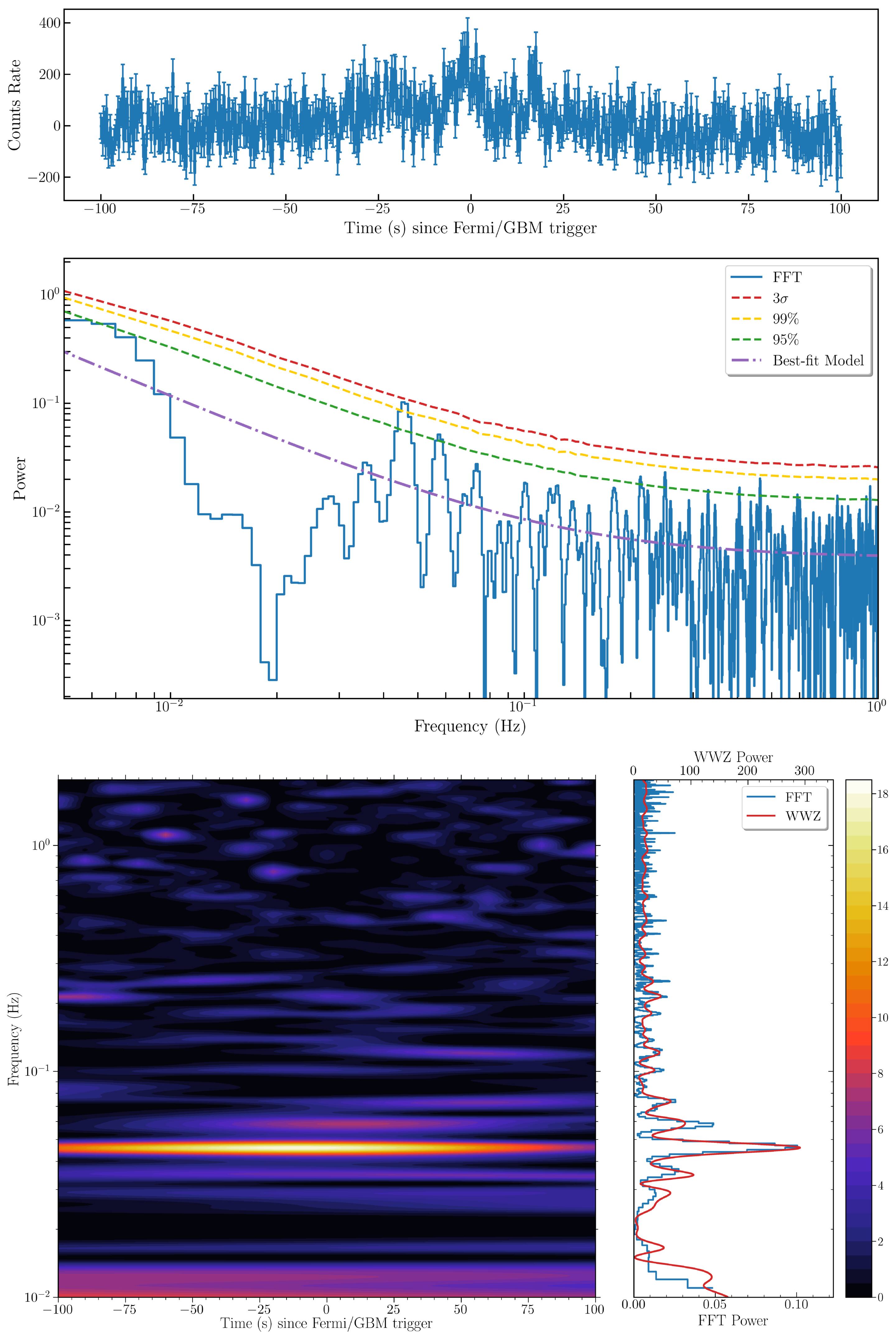
The light curve of the third trigger (GRB 250702E) along with its FFT and WWZ power spectra. (Image by SONG Feifan)
<関連情報>
- https://english.cas.cn/newsroom/research_news/phys/202511/t20251127_1134080.shtml
- https://iopscience.iop.org/article/10.3847/1538-4357/ae129e
GRB 250702DBE/EP250702a の特異なイベントで準周期振動信号が存在する可能性はあるか? Possible Quasiperiodic Oscillation Signals in the Unique Event of GRB 250702DBE/EP250702a?
Fei-Fan Song and Jirong Mao
The Astrophysical Journal Published: 2025 November 12
DOI:10.3847/1538-4357/ae129e
Abstract
GRB 250702DBE was time consequently triggered by the Gamma-ray Burst Monitor (GBM) on board the Fermi satellite. It is uncertain which celestial catalog is suitable for this special ultralong event to belong to. In this paper, we comprehensively investigate the lightcurves obtained by Fermi GBM detectors. In the energy band of 8–1000 keV, no quasiperiodic oscillation (QPO) signals are found in the lightcurve of the first burst 250702D, a possible QPO signal of 0.046 Hz corresponding to a period of 21.7 s is found in the lightcurve of the second burst 250702B, and a possible QPO signal of 0.024 Hz corresponding to a period of 41.7 s is found in the lightcurve of last burst 250702E. The significance level of the possible QPO signals is comprehensively examined. In addition, we examine the spectral properties of the sources. In general, a broken power law is suitable for modeling the spectral data from 8 keV to 40 MeV. We qualitatively suggest some kinds of celestial object with the periodic characteristic that might be the progenitors of this unique event.