
2025-11-27 統計数理研究所
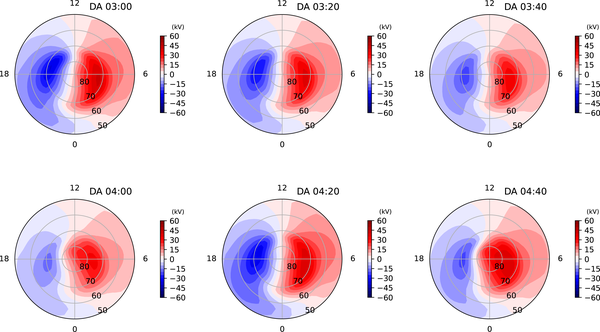
図1 エミュレータにデータ同化を適用して推定された2017年3月27日の3:00~4:40 UTの20分ごとの極域電離圏電場ポテンシャルの分布
電場ポテンシャル分布からただちに電場分布を求めることができる。これは、限られた領域しか得られない観測データから数学的に補間して作成されたSuperDARNの「宇宙天気図」と比較して、磁気圏および電離圏の物理過程を取り入れた、より正確な「宇宙天気図」であると言える。
<関連情報>
- https://www.ism.ac.jp/ura/press/ISM2025-07.html
- https://www.ism.ac.jp/ura/press/ISM2025-07/pr20251127.pdf
- https://agupubs.onlinelibrary.wiley.com/doi/10.1029/2025SW004488
極域電離層解析のための全球MHDシミュレーションの機械学習ベースエミュレータへのデータ同化 Data Assimilation Into a Machine Learning-Based Emulator of a Global MHD Simulation for Analyzing the Polar Ionosphere
Shin’ya Nakano, Sachin Alexander Reddy, Ryuho Kataoka, Aoi Nakamizo, Shigeru Fujita, Akira Sessai Yukimatu
Space Weather Published: 24 November 2025
DOI:https://doi.org/10.1029/2025SW004488
Abstract
The temporal evolution of the polar ionosphere’s electric field distribution can be simulated by a magnetohydrodynamic (MHD) model of the magnetosphere–ionosphere system. The emulator SMRAI2 mimics the ionospheric state calculated with an MHD model, REPPU, under given solar wind conditions. We derive an updated version, SMRAI2.1, which predicts the electric field distribution in the polar ionosphere as a smooth spatial function. This enables us to easily obtain the plasma drift velocity for comparison with radar observations. We then compare the output of SMRAI2.1 with SuperDARN line-of-sight velocity data and confirm that the emulator can predict the observed line-of-sight velocity better than a naive prediction assuming zero drift velocity and that it well predicts the direction of the line-of-sight velocity. In addition, we propose a method using a data assimilation technique for incorporating the SuperDARN data into the emulator. The results of the assimilation shows that the electric field in the polar ionosphere is more variable than the emulator predicts. This suggests that the emulator prediction could be less variable than the real ionosphere and that it is effective to combine real observations and the emulator for reproducing the polar ionospheric environment.
Plain Language Summary
The ionospheric condition can be predicted by a machine-learning-based model that mimics a numerical simulation model of the magnetosphere–ionosphere system. We assess this machine-learning-based model based on radar observations in the polar ionosphere. We have also developed a method to estimate the state of the polar ionosphere by combining the model prediction and radar observations. The results reproduced the variability of the polar ionosphere. The proposed method is a promising approach for investigating the polar ionospheric phenomena.
Key Points
- The emulator of a global magnetohydrodynamic simulation has been improved to allow comparison with SuperDARN data
- The electric potential distribution predicted with the emulator was compared to SuperDARN line-of-sight velocity data
- SuperDARN data were assimilated into the emulator to improve the emulator’s predictions


