2025-11-26 コペンハーゲン大学(UCPH)
<関連情報>
- https://news.ku.dk/all_news/2025/11/over-half-of-global-coastal-settlements-are-retreating-inland-due-to-intensifying-climate-risks/
- https://www.nature.com/articles/s41558-025-02435-6
沿岸気候災害に対する脆弱性により、世界的に沿岸部の人間居住地が後退している Global coastal human settlement retreat driven by vulnerability to coastal climate hazards
Lilai Xu,Xue Yang,Deliang Chen,Didier Sornette,Alexander V. Prishchepov,Shengping Ding,Wang Pang,Krishna Suryanto Pribadi,Baofeng Di & Xiaoming Wang
Nature Climate Change Published:22 September 2025
DOI:https://doi.org/10.1038/s41558-025-02435-6
Abstract
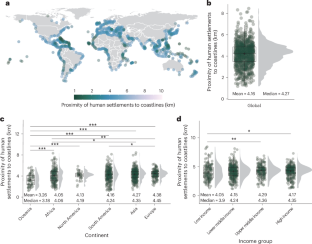
Retreating from coastlines is one potential human response to the increasing threats posed by coastal climate hazards. However, the global extent of coastal settlement retreat, its correlation with local vulnerabilities, and the adaptation gaps remain less understood. Here we analyse night-time light changes for 1992 to 2019 and show that settlements retreated from coastlines in 56% of coastal subnational regions, remained stable in 28%, and moved closer to coastlines in 16% of these regions. Retreat was weakly associated with historical experiences of coastal climate hazards but accelerated in regions with greater vulnerability to coastal climate hazards—indicated by lower infrastructure protection and less adaptive capacity. In 46% of low-income regions, particularly in Africa and Asia, settlements were forced to either maintain their current status quo or move closer to coastlines, revealing the large adaptation gap in addressing future climate change risks.