2025-11-25 テキサス大学オースチン校(UT Austin)
<関連情報>
- https://news.utexas.edu/2025/11/25/ut-utsa-students-find-black-hole/
- https://iopscience.iop.org/article/10.3847/2041-8213/ae0b4f
超大質量ブラックホールを持つ「暗黒物質優勢」矮小銀河Segue 1のモデル化 Modeling the “Dark-matter Dominated” Dwarf Galaxy Segue 1 with a Supermassive Black Hole
Nathaniel Lujan, Karl Gebhardt, Richard Anantua, Owen Chase, Maya H. Debski, Claire Finley, Loraine V. Gomez, Om Gupta, Alex J. Lawson, Izabella Marron,…
The Astrophysical Journal Letters Published: 2025 October 14
DOI:10.3847/2041-8213/ae0b4f
Abstract
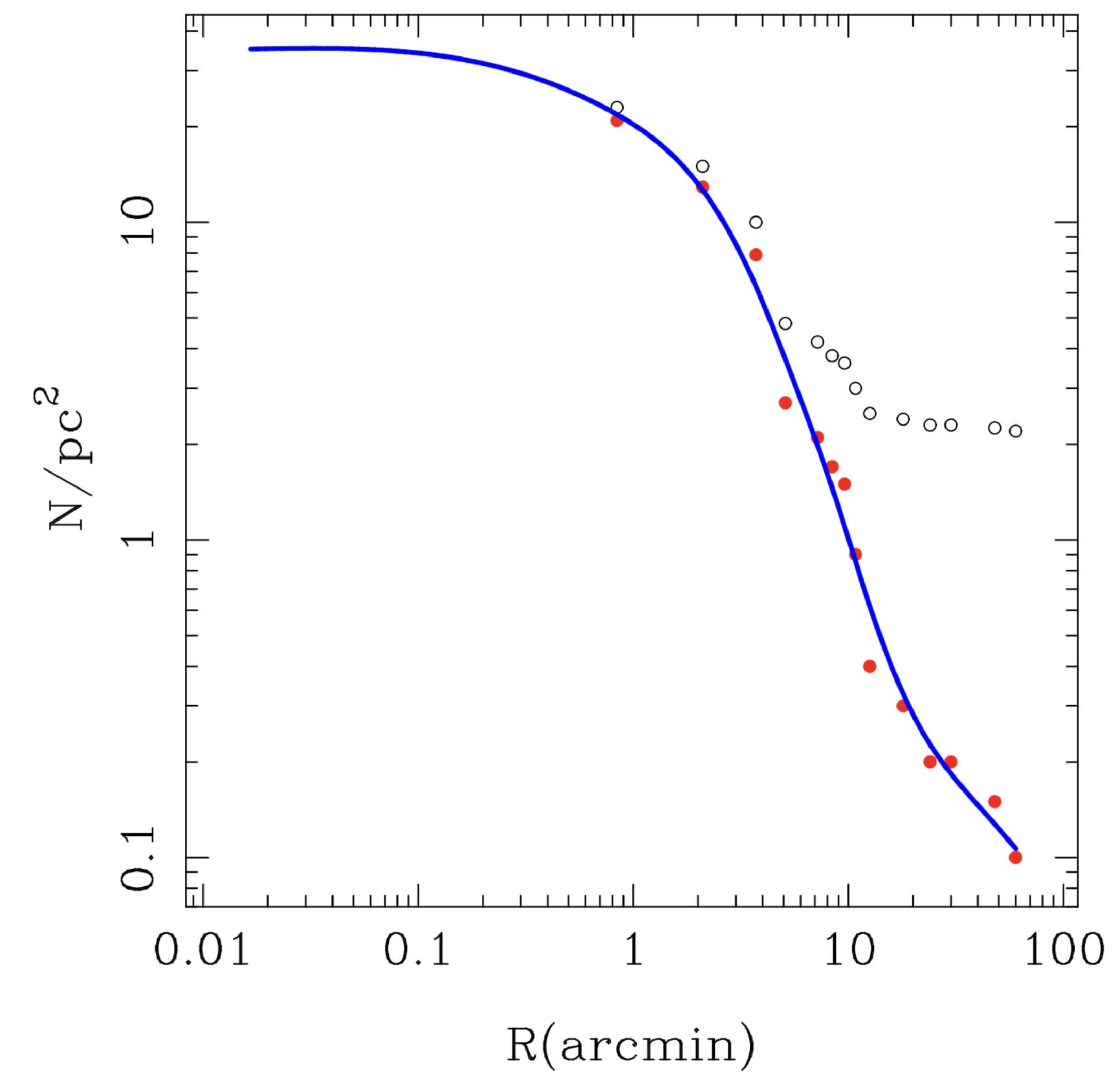
The dwarf spheroidal galaxy, Segue 1, is thought to have one of the largest ratios of dark matter to stellar mass. Using orbit-based dynamical models, we model Segue 1, including a dark halo and a central black hole. The best-fit model requires a black hole mass of 4.5 ± 1.5 × 10⁵ M⊙. The value of the black hole mass is similar either with or without a dark halo. The mass-to-light ratio of the stars is poorly constrained by the dynamical modeling, reflecting that Segue 1 is dominated by mass other than stars. Dynamical models that exclude a black hole provide a worse fit and require a dark halo with very-small-scale radii of below 100 pc. Additionally, the zero black hole models require a stellar orbital distribution that is highly radially biased. The model with a black hole provides an orbital structure that is close to isotropic, more similar to other well-studied systems. We argue that the two-parameter models of stars and black hole provide a better description of Segue 1 than the three-parameter models of stars and two dark halo components. Additional support for a central black hole comes from a significant increase in the central rotation. Using individual velocities, we measure a rotation amplitude of 9.0 ± 2.4 km s−1. Segue 1 is likely being tidally stripped at large radii, and we might be witnessing the remnant nucleus of a more massive system. Alternatively, given the high black hole mass relative to the stellar mass, Segue 1 is analogous to the Little Red Dots seen in the early Universe.