2025-11-21 ミュンヘン大学(LMU)
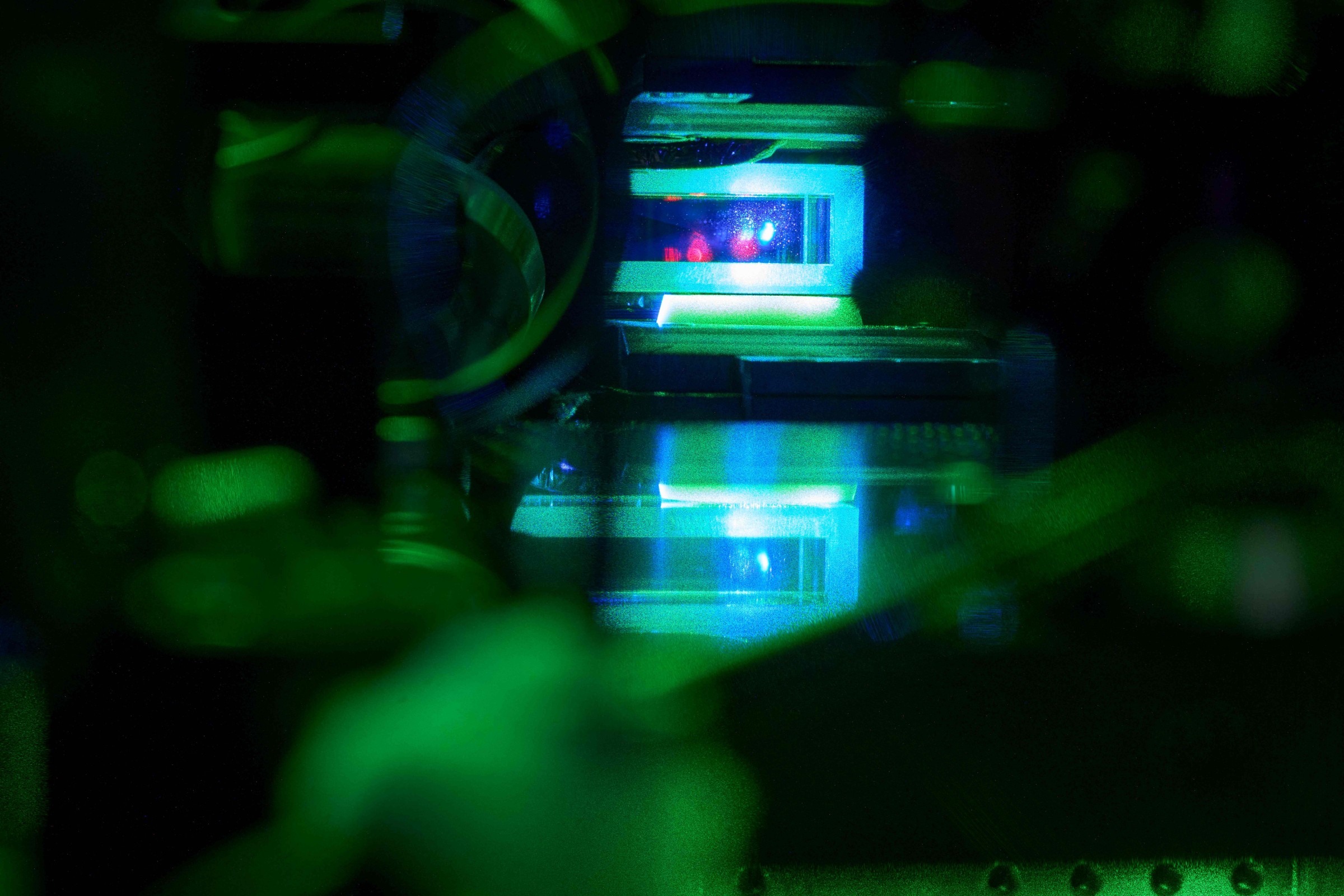
Cold atoms in a light trap. The researchers conducted their experiment in a setup like this. | © MQV / Jan Greune
<関連情報>
- https://www.lmu.de/en/newsroom/news-overview/news/quantum-simulation-making-collective-phenomena-visible.html
- https://www.science.org/doi/10.1126/science.adq7082
リュードベリ装いの拡張ボーズ・ハバード模型の実現 Realization of a Rydberg-dressed extended Bose-Hubbard model
Pascal Weckesser, Kritsana Srakaew, Tizian Blatz, David Wei, […] , and Johannes Zeiher
Science Published:20 Nov 2025
DOI:https://doi.org/10.1126/science.adq7082
Editor’s summary
Ultracold atoms in optical lattices have been used extensively to simulate the behavior of the Hubbard model, which describes the physics of interacting particles on a lattice. However, past studies focused largely on on-site interactions, which are easier to implement experimentally. Weckesser et al. used the so-called Rydberg dressing technique to create extended-range interactions between rubidium atoms residing in a one-dimensional optical lattice. The researchers used a stroboscopic dressing sequence to control the losses that plagued prior implementations and studied both equilibrium and nonequilibrium behavior of the resulting extended Hubbard model. —Jelena Stajic
Abstract
The competition of different length scales in quantum many-body systems leads to phenomena such as correlated dynamics and nonlocal order. To investigate such effects in an itinerant lattice-based quantum simulator, it has been proposed to introduce tunable extended-range interactions using off-resonant optical coupling to Rydberg states, known as Rydberg dressing. In this work, we use this approach to realize an effective one-dimensional extended Bose-Hubbard model. Harnessing our quantum gas microscope, we probe the correlated out-of-equilibrium dynamics of extended-range repulsively bound pairs and “hard rods.” By contrast, operating near equilibrium, we observe density ordering when adiabatically turning on the extended-range interactions. Our results pave the way to realizing light-controlled extended-range interacting quantum many-body systems.