2025-11-20 東京科学大学
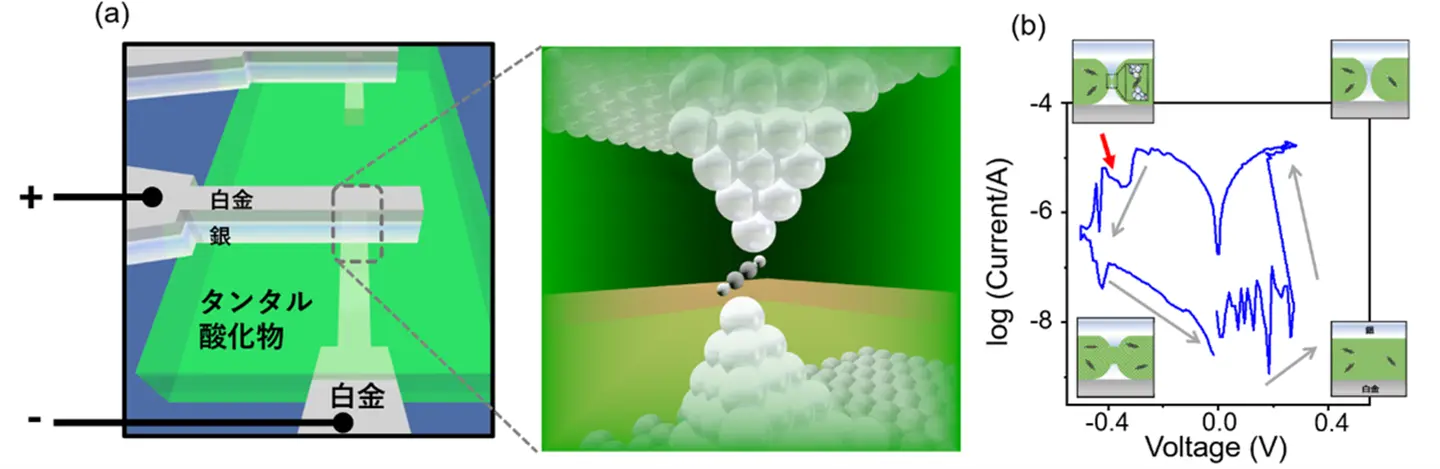
図1. (a)本研究で作製した素子の概念図 (b)印加電圧操作によるアセチレン分子接合の作製
<関連情報>
- https://www.isct.ac.jp/ja/news/q6w4t4h6gdpk
- https://www.isct.ac.jp/plugins/cms/component_download_file.php?type=2&pageId=&contentsId=1&contentsDataId=2664&prevId=&key=dec0f4fb9951fe43786f499ef7747aa7.pdf
- https://onlinelibrary.wiley.com/doi/10.1002/smll.202507653
分子エレクトロニクスデバイスのプラットフォームとしての酸化還元誘起原子スイッチ Redox-Induced Atomic Switch as Platform for Molecular Electronics Devices
Akira Aiba, Marius Buerkle, Satoshi Kaneko, Tohru Tsuruoka, Sekito Nishimuro, Kazuya Terabe, Tomoaki Nishino
Small Published: 25 October 2025
DOI:https://doi.org/10.1002/smll.202507653
Abstract
Molecular electronics is attracting increasing attention due to its potential application in post-silicon electronics. However, fabrication of molecular junctions, the fundamental building block of molecular electronic devices, requires complicated procedures, which hamper the efficient development of novel devices. Here, a simple fabrication process by utilizing an atomic switch operated by redox reaction and migration of metal atoms are proposed. The Ta2O5-based silver atomic switches are operated with a small operation voltage (0.3 V) in an acetylene atmosphere under an ultra-high vacuum. The consecutive operation of the atomic switch shows novel conductive states around 0.1 G0 (G0 = 2e2/h). Inelastic electron tunneling spectra and first-principles calculations reveal that the observed conductive states are attributed to the acetylene molecular junctions on the silver filament. The proposed method accelerates the development of devices through the marriage of molecular junctions with atomic conductive filaments.