2025-11-21 東京科学大学
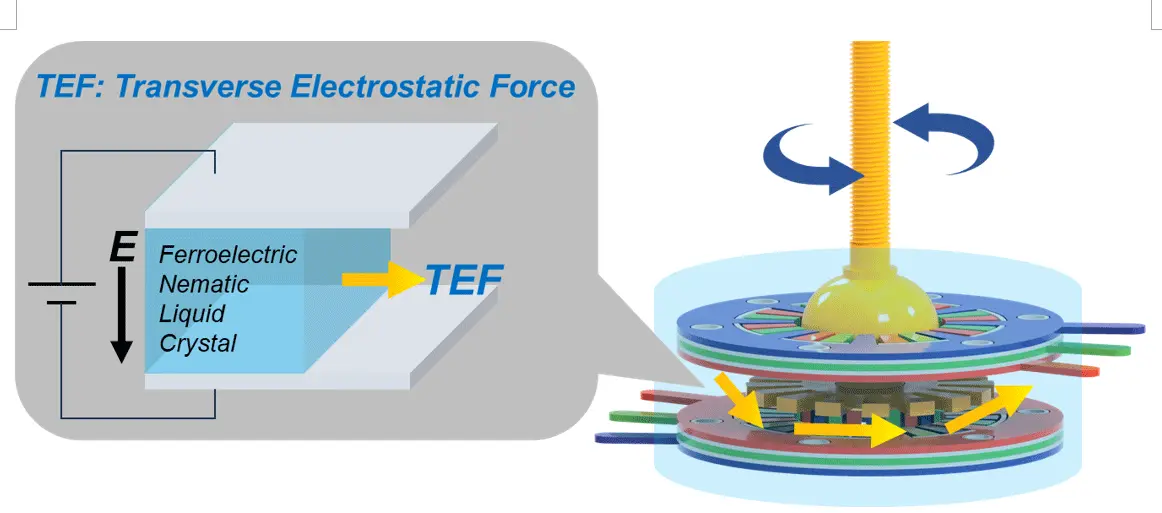
図1.電界に垂直方向に働く静電力TEFを利用した強誘電モータの概念図
<関連情報>
- https://www.isct.ac.jp/ja/news/wiaa9q94gxtr
- https://www.isct.ac.jp/plugins/cms/component_download_file.php?type=2&pageId=&contentsId=1&contentsDataId=2568&prevId=&key=0d8f51134e904c4ecd0df
- https://www.nature.com/articles/s44172-025-00530-2
強誘電流体における巨大な横方向マクスウェル応力と新しい強誘電モーターの試作 Huge transverse Maxwell stress in ferroelectric fluids and prototyping of new ferroelectric motors
Tatsuhiro Tsukamoto & Suzushi Nishimura
Communications Engineering Published:19 November 2025
DOI:https://doi.org/10.1038/s44172-025-00530-2
Abstract
Electrostatic actuators typically rely on Maxwell stress, whereas the use of transverse electrostatic force (TEF) has been overlooked because of its weakness. The discovery of polar nematic liquid crystals in 2017 changed this, enabling lower operating voltages and high output power. We here explore TEF in a ferroelectric fluid and demonstrate a ferroelectric motor based on a new driving principle. Using ferroelectric nematic liquid crystals, we show that TEF can elevate the fluid between electrodes with a gap of 2.5 mm up to more than 80 mm at only 28 V mm−1, corresponding to a stress greater than 1000 N m−2. Polarization analysis also revealed a continuous paraelectric-to-ferroelectric transition. Unlike electromagnetic motors, ferroelectric motors require no metal rotors or magnets, resulting in a lower weight and simplified device structure and eliminating the need for rare-earth materials. These results suggest that ferroelectric fluids can enhance electrostatic actuator performance and practicability.